
China Visa for School Groups: 2027 Rules and Timeline
Whether you need a China visa for school groups depends on each passport in the group, not on the group itself. About 50 nationalities currently enter visa-free for 30 days, but that policy runs only to December 31, 2026, and no extension into 2027 had been announced as of September 2026. So plan any 2027 departure as if visas will be required. Start the under-18 paperwork early, and build the timeline around the slowest passport in the group.
Key takeaways
- Roughly 50 nationalities enter visa-free for 30 days, and the policy expires December 31, 2026.
- US, Indian, Philippine, Nigerian, South African and Pakistani passport holders need a visa now.
- School groups normally travel on the L category, not a study visa.
- Under-18s need parental consent letters and guardianship evidence on top of the standard file.
- Children under 14 are exempt from fingerprinting; students aged 14 to 17 usually are not.
Who needs a visa, and who does not
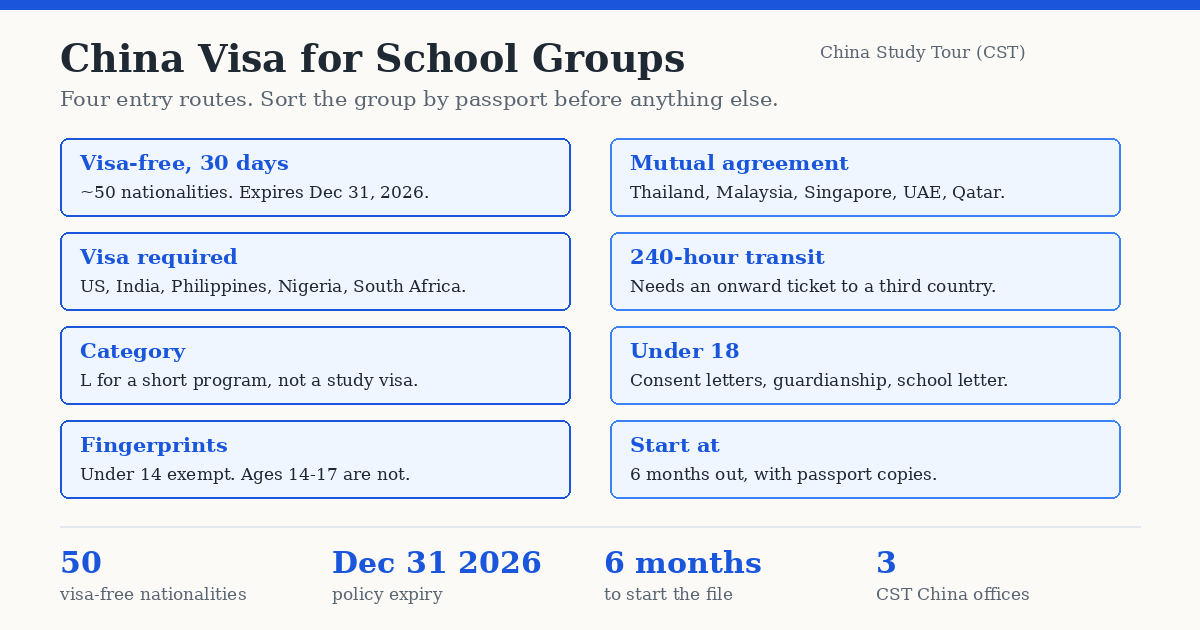
Four separate entry routes run in parallel, and schools regularly plan against the wrong one. Sort your group by passport before anything else.
| Route | Who it covers | What it means for a school group |
|---|---|---|
| Unilateral visa-free, 30 days. | Around 50 nationalities, including most of Europe, the UK, Canada, Australia, New Zealand, Japan, South Korea, Brazil and Argentina. | No visa needed, but the policy is dated and expires at the end of 2026. |
| Mutual-agreement visa-free. | Thailand, Malaysia, Singapore, the UAE and Qatar, among others. | Not tied to the December expiry, so these students are the least exposed. |
| Visa required. | United States, India, the Philippines, Nigeria, Pakistan, South Africa, Bangladesh and most others. | Full application per student, so this group sets your timeline. |
| 240-hour transit. | Around 57 nationalities, including the United States. | Requires an onward ticket to a third country, so it rarely fits a round-trip school itinerary. |
The United Kingdom and Canada joined the visa-free list in February 2026. That is recent enough that older planning documents still list them as needing visas. If your school last traveled to China before that, check your own file before you repeat its instructions.
The 2027 problem most itineraries ignore
This is the part worth taking to your trip committee. The unilateral visa-free policy has been extended year by year since late 2023, and the current extension ends at 24:00 Beijing time on December 31, 2026. As of September 2026 no extension into 2027 had been announced.
School trips are planned six to twelve months out. A group traveling in spring 2027 is being costed and approved right now, under rules that lapse before departure. The policy may well be renewed. Planning on the assumption that it will be is the risk.
The workable approach is to design the trip so that either outcome is survivable. Build the visa timeline in even for visa-free nationalities. Keep application fees in the budget as a contingency line, and warn parents that requirements may change. If the extension arrives, you drop a task. If it does not, you are not scrambling in February.
Which visa category a school group uses
China does not issue a dedicated minor or school category. A group traveling for a short educational and cultural program normally applies under the L category, the tourist classification. Study categories are for enrollment on a course lasting a term or longer. They do not fit a one-week program, however academic the itinerary.
Category errors are the most common self-inflicted problem when a school applies independently. The itinerary decides the category, not the word on the invitation letter. Describe the trip accurately, and keep the wording consistent across every student's file.
Extra documents for students under 18
Minors apply under the same categories as adults and then add paperwork that proves consent and guardianship. Requirements vary by consulate, so treat this as the common core rather than a final list.
| Document | What it needs to show | Where schools go wrong |
|---|---|---|
| Parental consent letter. | Both parents agree to the trip and name the accompanying adult. | Only one parent signs, or the letter is not notarized where the consulate requires it. |
| Birth certificate or guardianship proof. | The relationship between the student and the consenting adults. | Separated families with custody documents that do not match the surname. |
| Copies of parents' passports or ID. | Identity of the signatories. | Expired documents supplied because nobody checked. |
| School letter. | The student is enrolled, and the trip is a school program. | Sent on plain paper without letterhead or a signature. |
| Invitation letter from the host in China. | Dates, itinerary, accommodation and host contact details. | Requested too late to reach every consulate before appointments. |
Fingerprints and appointments
Biometric collection is the detail that decides whether your group can apply by post or has to travel to a visa center. Children under 14 are exempt, as are applicants over 70, according to Chinese embassy guidance on the fingerprint requirement. Students aged 14 to 17 fall inside the requirement.
Temporary suspensions of fingerprint collection have applied to some short-stay categories in recent years. They are renewed or dropped without much notice. Confirm the current position with the visa center that serves your school. A class of sixteen-year-olds attending in person is a logistics exercise. A postal application is an afternoon of envelopes.
Mixed-nationality groups, which is most international schools
A single year group at an international school can hold fifteen passports. Each one follows its own rule, and the group travels on the slowest of them.
Build the list early, sort it into the four routes above, and identify the students who need a full application. Those students set every deadline that follows. Two further traps are worth naming. Residency matters as well as nationality. Many consulates accept applications only from residents of their district, so a student applies where they live rather than where the passport was issued. Students with two passports should travel on whichever makes entry simplest. Use that same passport for the flight booking and the whole trip.
The timeline to work back from
Counting backward from departure keeps the visa work ahead of the travel work rather than behind it.
| When | Action |
|---|---|
| 6 months out. | Collect passport copies from every student and adult. Check expiry dates against airline and entry requirements, and sort the group by entry route. |
| 4 months out. | Confirm which students need applications. Book visa center appointments if fingerprints are required, because school-holiday slots fill first. |
| 3 months out. | Request the invitation letter with final dates, hotels and itinerary. Start the consent letters and any notarization. |
| 8 to 10 weeks out. | Submit applications. Keep a tracking sheet with one row per student and the status of each document. |
| 4 weeks out. | Confirm every passport is back in hand. Chase anything outstanding now, while a replacement plan is still possible. |
| 2 weeks out. | Send the passenger list with passport numbers to your operator for company visits and hotel registration. |
The invitation letter comes from the host organization in China, not from the school, and it has to match the itinerary that visits are booked against. The same passenger list then clears your group into corporate campuses, which accept outside visitors through pre-vetted partners rather than cold outreach. CST's access rests on 13+ years of partner relationships, which is also why a late name change can mean re-running clearance for that student.
Passport rules that catch groups out
Three checks prevent nearly every late problem. Confirm that each passport has at least six months of validity beyond the return date. Check for blank pages if a visa label is needed. Confirm that the name on the ticket matches the passport exactly, including middle names. School lists and airline bookings drift apart. Finally, check any student whose passport is mid-renewal. A renewal and a visa application cannot run at the same time.
Once entry is settled, the rest of the planning sits alongside it on the school trips to China overview, and the documentation your board will want sits under China school trip safety.
Frequently asked questions
Do students need a China visa for school groups in 2027?
Probably, unless the visa-free policy is extended. About 50 nationalities enter visa-free for 30 days under the current policy, which expires on December 31, 2026, with no 2027 extension announced as of September 2026. Plan a 2027 trip on the assumption that applications will be needed. Treat an extension as good news, not a premise.
Which visa category should a school group apply for?
Normally the L category, which covers short tourist and cultural travel. Study categories are for enrollment on courses lasting a term or longer. They do not suit a one-week program. Describe the itinerary accurately, and keep the wording identical across every student's application.
What extra documents do under-18 students need?
A parental consent letter signed by both parents. Evidence of the relationship, such as a birth certificate. Copies of the parents' identity documents, a school letter confirming enrollment, and the invitation letter from the host in China. Some consulates require the consent letter to be notarized, so check yours before collecting signatures.
Do students have to give fingerprints?
Children under 14 are exempt, and applicants over 70 are too. Students aged 14 to 17 fall inside the requirement. Temporary suspensions have applied to some short-stay categories. Confirm the current position with the visa center serving your school, because it decides whether you apply by post or in person.
How do we handle a group with many different nationalities?
Sort the list by passport at the start. Identify the students who need a full application, and build every deadline around them. Watch residency as well as nationality, since most consulates accept applications only from residents of their district.
Does CST help with the visa process?
Yes. CST issues the invitation letter, provides a documentation checklist per nationality, and works in English, Chinese, Spanish, Portuguese, and Japanese. All guides are bilingual, and additional language support is available upon request. The applications themselves are submitted by the school or the families.
Get the visa checklist for your group
Send your travel dates and the nationalities in your group. You get the entry route for each passport, the document list per consulate, and an invitation letter matched to your itinerary.
Request a school proposal