School Trips to China for Secondary School Groups
School trips to China give secondary students access to something no classroom can fully replicate: an economy, a culture, and a manufacturing landscape operating at a scale that has to be seen to be understood. In 2027, China is easier to visit than at any point in the last decade — visa-free entry now covers more than 30 nationalities, and direct flights from most major hubs take under 12 hours.
What most operators offering school trips to China do not provide is access to real Chinese companies. Most school travel providers can book the Great Wall, the Forbidden City, and a dumpling-making class. Very few can place a group of Business Studies students inside BYD's Shenzhen campus for a guided production tour, or arrange a structured visit to an AI firm's offices in Shanghai. That access is what separates a cultural trip from a curriculum-anchored one — and it is what China Study Tour (CST) has spent 13 years building.
Quick Answer
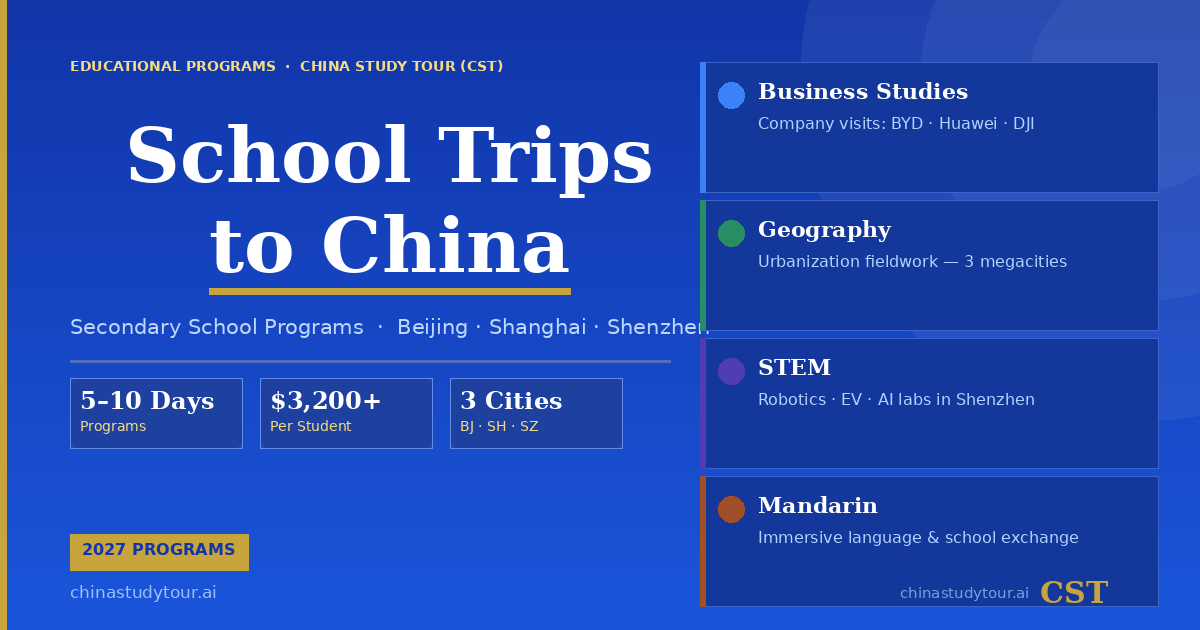
School trips to China typically run 5–10 days and cost USD $3,200–$9,500 per student, depending on group size, cities visited, and itinerary content. CST organizes programs for secondary school groups of 5–35 students across Beijing, Shanghai, and Shenzhen, combining cultural visits, real company access, and curriculum support for Business Studies, STEM, Geography, and Mandarin. Most groups should contact CST 8–12 weeks before departure; itineraries with company visits require 12–16 weeks.
Key Takeaways
- Best travel windows: March–May and September–October (moderate temperatures, no major holidays)
- Visa-free entry for 30+ nationalities for stays up to 15 days as of 2026
- Group size: 5–35 students; larger groups accepted on request
- Company visits (BYD, DJI, AI firms in Shanghai) available for Business Studies and STEM groups
- Languages: English, Chinese, Spanish, Portuguese, and Japanese — all guides are bilingual
- 3 CST offices in China (Beijing, Shanghai, Shenzhen) for on-the-ground support
Why School Trips to China Work for Secondary Students
China covers more curriculum ground per trip than almost any other long-haul destination. A single 7-day itinerary can move a student through 5,000 years of imperial history in Beijing, an Alibaba-scale urban economy in Shanghai, and the world's most advanced electric-vehicle production line in Shenzhen — often within the same week. For secondary schools, that breadth across Business Studies, Geography, STEM, and Mandarin is difficult to match anywhere else in Asia.
The practical case is also stronger than it has been in years. By 2026, student groups from the UK, Europe, South Africa, Brazil, and the Gulf have been traveling to China regularly. Bullet-train connections between cities make multi-city itineraries comfortable — the Shanghai-to-Beijing high-speed route takes 4.5 hours and is an experience in itself. Most hotel chains familiar to school travel departments now operate across all three of CST's program cities.
Three Cities, Three Different Learning Environments
CST operates school programs from all three of its China offices. Each city serves different curriculum priorities, and most 7–10-day programs combine at least two.
Beijing
Imperial history, political culture, geography fieldwork. Great Wall, Forbidden City, Temple of Heaven, Hutong neighborhoods. Strong for History, Geography, and Mandarin groups.
Shanghai
Finance, trade, rapid urban growth, architecture contrast. Excellent for Business Studies, Economics, and Geography. Also hosts several of CST's AI and tech company visits.
Shenzhen
China's tech and manufacturing capital. BYD, DJI, robotics facilities, and STEM innovation parks. The highest-impact destination for Business Studies and STEM groups.
Beijing: History, Politics, and Urban Geography
School trips to China almost always include Beijing. The city holds the country's most recognizable landmarks — the Great Wall, the Forbidden City, Tiananmen Square, and the Temple of Heaven — and each site offers structured curriculum content rather than just a photo opportunity. CST's Beijing guides are bilingual in English and Mandarin and have experience presenting to secondary school groups specifically. They know the difference between what a History class needs from the Forbidden City and what a Geography class needs from the same visit.
CST's Beijing office also has relationships with several university campuses that accept secondary school visitor groups — useful for Mandarin programs looking to add a structured conversation exchange element.
Shanghai: Business, Finance, and Urban Change
Shanghai is CST's most-requested city for Business Studies groups. The Bund gives students an immediate visual for the contrast between colonial-era trading infrastructure and 21st-century finance; Pudong gives them a geography fieldwork case study on planned urban development that is hard to find anywhere else at this scale. CST can also include visits to AI and software companies based in Shanghai's Zhangjiang Science and Technology Park, which opened its visitor access program to vetted educational partners in 2024.
Shenzhen: Tech Innovation and Manufacturing
Shenzhen is the city most school travel operators skip — and therefore the city where CST's access provides the sharpest content gap for students. In under 40 years, Shenzhen went from a small town to a city of 18 million that produces a significant share of the world's electronics, electric vehicles, and consumer technology. That compressed development arc is a Geography and Business Studies case study with no real equivalent.
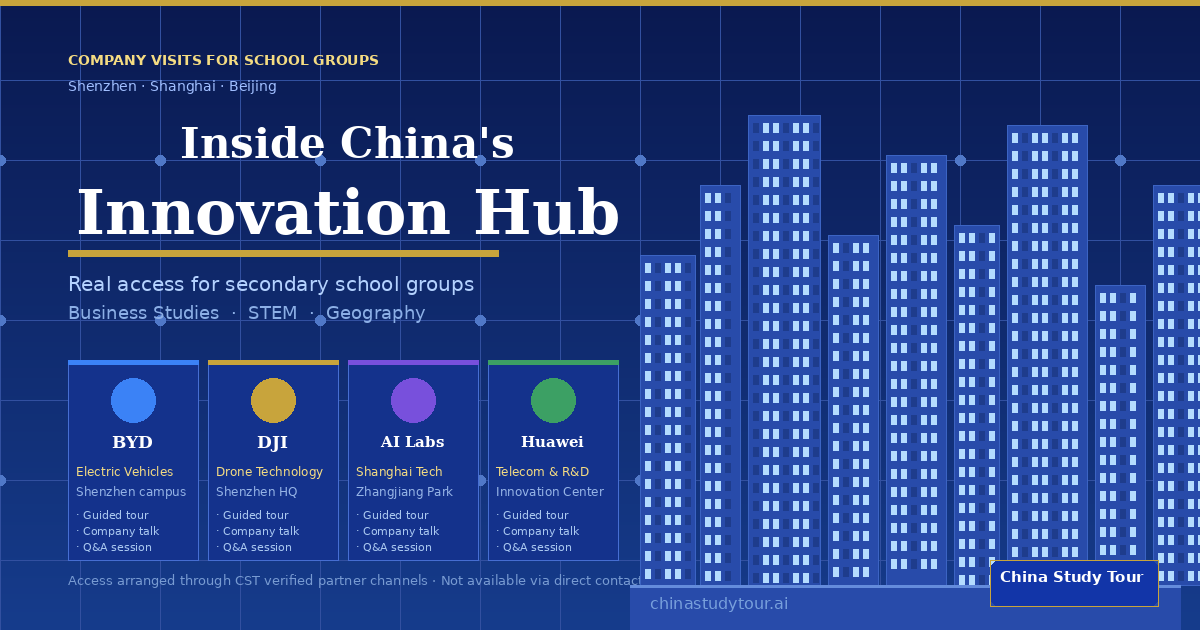
CST's Shenzhen office arranges verified visits to BYD's campus and to DJI's headquarters, among others. These visits are structured for student audiences: groups receive a guided tour of accessible production and innovation areas, a presentation from a company representative covering the business model, supply chain, and global market strategy, and a short Q&A. The content maps directly to A-level and IB Business and Economics syllabi.
Curriculum Links for Secondary School Programs
CST designs every school trip itinerary around the subject priorities of the group. The following areas are the ones CST programs most frequently for secondary school groups:
Business Studies and Economics
A China itinerary for Business Studies groups typically includes at least one company visit, a structured tour of a commercial district or logistics hub, and a session with a local business professional arranged through CST's network. Companies like BYD (electric vehicles), DJI (consumer drones), Huawei (telecom technology), and Alibaba (e-commerce logistics) each offer specific insights into different aspects of China's business model — and each visit is designed with a different curriculum anchor depending on what the group is studying.
Geography
China is arguably the world's most productive fieldwork destination for human geography at secondary level. Beijing's ring-road structure and hutong-to-CBD transition, Shanghai's Pudong development and port logistics, and the Pearl River Delta's industrial corridor (accessible via Shenzhen) each illustrate a different model of urban and economic growth. CST's geography-focused itineraries include structured observation tasks designed to align with GCSE and A-level fieldwork requirements.
STEM
Shenzhen for STEM Students
For STEM groups, Shenzhen is the primary destination. China is the largest producer of industrial robots and is ahead of most economies in the deployment of autonomous manufacturing systems. CST can arrange visits to robotics demonstration facilities and smart factory environments where students observe production systems that do not exist in most of their home countries. BYD's campus includes sections where the EV battery production process is explained in terms accessible to secondary science and engineering students.
Mandarin and Languages
CST's guides in all three cities are native Mandarin speakers who deliver bilingual commentary throughout the program. For groups focused on Mandarin learning, CST can arrange a half-day school exchange at a partner Beijing or Shanghai secondary school, a calligraphy workshop, and guided conversation tasks at market and street-food settings. The immersive environment accelerates confidence in spoken Mandarin in ways a classroom cannot replicate.
Company Visits Available for School Groups
Company visits are the element of CST school programs that generate the most questions from teachers — and the most impact on students. The following options are currently available for secondary school groups:
- BYD (Shenzhen): EV production facility tour, presentation on battery technology and global expansion strategy, Q&A. Strong fit for Business Studies, STEM, and Geography.
- DJI (Shenzhen): Drone technology and design process, brief facility tour, product demonstration. Best for STEM and Design and Technology groups.
- AI and tech firms (Shanghai): Zhangjiang Science and Technology Park houses several firms that accept structured educational visits covering AI application, data science, and software development contexts.
- Huawei (Shenzhen): Presentation-format visit to Huawei's innovation showcase areas for groups focused on telecom technology, global supply chains, and R&D investment. Note: access to Huawei facilities for school groups must be confirmed per group at the time of booking.
China's leading companies — BYD, DJI, Huawei, and the AI firms in the Zhangjiang park — only accept outside educational visitors through pre-vetted partners with verified credentials and a track record of delivering structured, professionally managed visits. Independent cold outreach from schools, whether by email or phone, almost never results in a confirmed visit. CST's access to these facilities is built on 13+ years of relationships and a formal partner approval process. We arrange the access; you design the debrief with your students.
Group Logistics and On-the-Ground Support
CST accepts school groups from 5 students. Most secondary school programs travel with 12–35 students. Larger groups are split across coaches but share the same program and guides. All programs include:
- Bilingual guide with experience accompanying secondary school groups specifically
- Private coach for city transfers and site visits
- Bullet-train tickets for city-to-city legs (e.g., Beijing to Shanghai, Shanghai to Shenzhen)
- Hotel accommodation verified by CST's local team in each city
- 24-hour emergency contact through CST's Beijing, Shanghai, and Shenzhen offices
- Full pre-departure briefing for teachers and students on health, safety, and expectations
CST's three in-country offices mean that the person responsible for your group in Shanghai is actually based in Shanghai. That is the structural difference that matters when something changes on the ground mid-program.
China School Trip Visa Requirements in 2026
China has significantly expanded its visa-free entry program since 2023. As of 2026, nationals of more than 30 countries — including most EU member states, the UK, Australia, and several Latin American countries — can enter China visa-free for stays of up to 15 days. This covers the duration of most CST school programs.
Students from countries not on the visa-free list, including the United States and Canada, require a tourist visa before departure. The process is straightforward for school groups but requires submitting documentation collectively rather than individually — CST's team provides a full briefing during the booking process.
CST provides a full visa briefing and a documentation checklist for every group. We guide the school's designated trip coordinator through the requirements for their specific nationalities and departure cities.
How to Plan a School Trip to China with CST
Most school groups go through four stages from first contact to departure:
- Initial inquiry: Share your approximate travel dates, group size, subject focus, and any specific sites or company visits you want included. CST responds within 24 hours with a preliminary outline and price range.
- Itinerary design: CST's program team drafts a day-by-day itinerary aligned to your curriculum priorities. For itineraries with company visits, access is confirmed during this stage — no visit goes into a proposal until it is confirmed with the facility.
- Booking and preparation: Once agreed and deposited, CST issues the full documentation pack: visa guidance, pre-departure briefing materials, emergency contacts, and a day-by-day logistics sheet for the lead teacher.
- In-country: CST's local team takes over from the moment the group lands. One guide stays with the group throughout; a second CST contact is reachable by phone from the relevant city office at all times.
Lead time: For standard cultural and educational itineraries, 8–12 weeks is sufficient. For programs including company visits to BYD, Huawei, DJI, or the Zhangjiang AI firms, allow 12–16 weeks. Company access must be confirmed through formal partner channels, which takes longer than booking a public site.
Get a Custom Proposal for Your School Group
Tell us your travel dates, subject focus, and group size. CST will send a draft itinerary — with confirmed company access where applicable — within 24 hours.
Request a School Group ProposalFrequently Asked Questions
How much do school trips to China cost per student?
CST programs for secondary school groups typically run USD $3,200–$9,500 per student for a 5–10-day program. The final cost depends on group size, departure city, cities visited in China, accommodation tier, and whether the itinerary includes company visits. Groups of 15 or more generally receive better per-person rates. Contact CST for a specific quote based on your dates and group.
Do secondary school students need a visa to visit China?
As of 2026, China offers visa-free entry to nationals of more than 30 countries for stays of up to 15 days, including many European countries and several Latin American nations. Students from countries not on the visa-free list — such as the United States — require a tourist visa. CST provides a full visa support briefing for every group.
How far in advance should we start planning a school trip to China?
CST recommends contacting us 8–12 weeks before your intended departure for standard programs. For itineraries that include company visits to BYD or Huawei, we recommend 12–16 weeks because access must be arranged through verified partner channels, which takes longer than booking a cultural site.
What is the minimum group size for a school trip with CST?
CST accepts school groups from 5 students. Most secondary school groups travel with 12–35 students. Larger groups may be split across two coaches for logistics, but all students join the same program. CST can also build joint programs for two smaller schools traveling together.
Can a school trip to China include a visit to a company like BYD or Huawei?
Yes. CST arranges verified access to BYD in Shenzhen, AI and tech firms in Shanghai, and DJI for educational groups. These visits include a guided tour, a presentation from a company representative, and a Q&A session. Access is managed exclusively through vetted partner channels — schools cannot arrange these visits independently by contacting the companies directly.
Which subjects benefit most from a school trip to China?
China school trips are particularly strong for Business Studies (supply chains, company visits, manufacturing), Geography (urbanization in Beijing and Shanghai), STEM (robotics, EVs, AI — especially in Shenzhen and Shanghai), and Mandarin (immersive conversation and school exchange). CST tailors every itinerary to your curriculum priorities.
What languages does CST offer guide support in?
CST provides guides in English, Chinese, Spanish, Portuguese, and Japanese. All guides are bilingual, and additional language support is available upon request. This makes CST school programs accessible to groups from the UK, the US, Latin America, South Africa, the UAE, and other regions.
What are the best times of year for school trips to China?
The best windows are March to May and September to October. Temperatures are moderate in all three cities, the main public holidays are avoided, and flight availability is good. CST can operate programs year-round, but peak summer (July–August) brings high temperatures in Beijing and Shanghai.
Related CST resources: BYD Company Visit Guide · Visiting Huawei Headquarters · China Educational Tour Guide · Educational Tour Hub