
China School Trip Operator: 8 Checks Before You Sign
A China school trip operator is not the same thing as a travel agency that sells a China package. The checks that separate them are concrete: a license that actually covers educational travel, an itinerary the company wrote itself, guides it employs, company access it can confirm in writing, and a price that reflects the cost of designing a program. This page gives you the eight questions to ask, and the answers that should end the conversation.
Key takeaways
- Ask for the business license and the registered business scope before you ask about price.
- Most agencies are middlemen. Find out who wrote the itinerary and who employs the guide.
- Access to BYD, DJI and Huawei runs through vetted partners, so ask how any company visit gets confirmed.
- A quote far under the field is usually a sightseeing tour with a study label on it.
- A real operator has the safeguarding pack ready before you ask for it.
Why the choice of operator decides the trip
China's own domestic study-travel market went through this problem first, and at scale. Surveys of Chinese school buyers put safety management at the top of their worries when they screen providers, with more than six in ten naming it first. Around 45% also report the other failure: programs that drift into sightseeing with an educational label attached.
Inbound groups face the same two risks with a language barrier on top. The category is crowded because the barrier to entry is low. Travel agencies, education consultancies, culture companies and one-person intermediaries all describe themselves the same way on a website, and a school comparing three proposals cannot see which one will actually be standing in the hotel lobby at 6 a.m. when a student is unwell.
The good news is that the differences show up fast under direct questions. A China school trip operator that builds its own programs answers these in specifics. A reseller answers in adjectives.
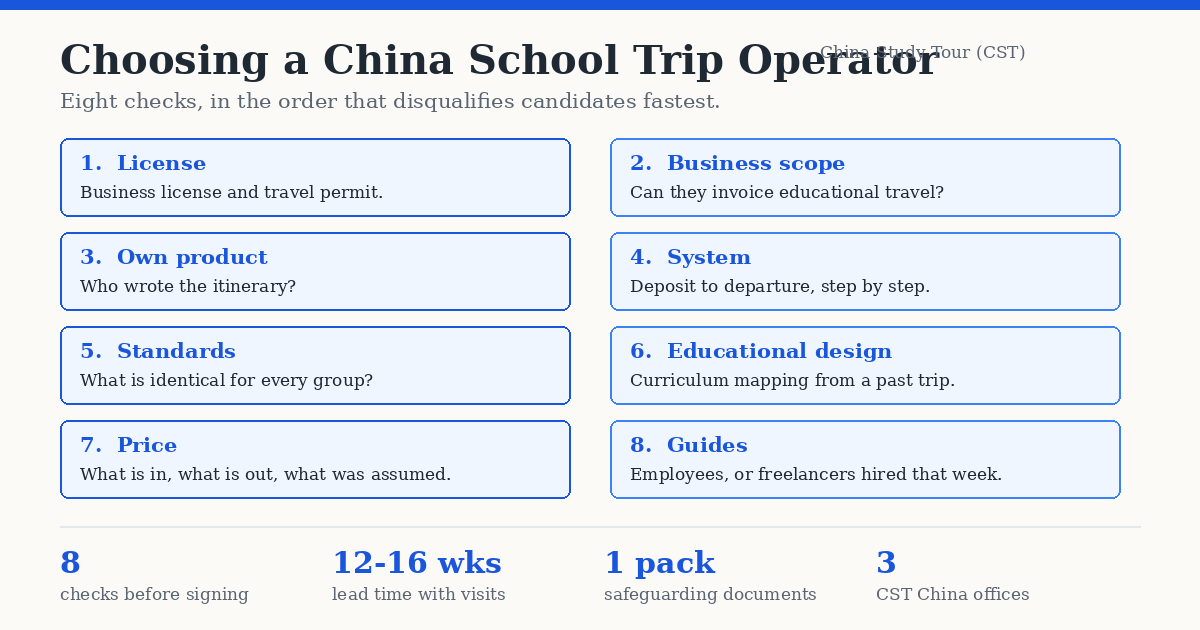
The eight checks
Work through these in order. The first two take five minutes and disqualify a surprising number of candidates.
| Check | Ask exactly this | Warning sign |
|---|---|---|
| 1. License | Send me your business license and your travel service permit. | A brochure arrives instead of a document, or the entity named on it differs from the one on the contract. |
| 2. Business scope | Does your registered scope cover educational travel, and can you invoice it as such? | The scope reads "culture communication" only, or invoicing has to go through a third company. |
| 3. Own product | Who wrote this itinerary, and can you change day three while I wait? | Changes take days because a supplier has to be asked. |
| 4. System | Walk me through what happens from deposit to departure. | No named stages, no documentation pack, no handover point. |
| 5. Standards | What is identical for every group you run, regardless of guide? | Quality is described as depending on which guide you get. |
| 6. Educational design | Show me the curriculum mapping for a trip you ran last year. | The learning outcomes are written after the itinerary, or not at all. |
| 7. Price | What is in the price, what is excluded, and what did you assume about group size? | A single number with no breakdown, well under the other quotes. |
| 8. Guides | Are the guides your employees, and have they worked with school groups? | Freelancers hired per trip, assigned the week before departure. |
Own product, or a middleman
This is the check that explains most of the others. A large share of traditional agencies do not have products of their own. They sit between the buyer and a network of suppliers, adding a margin and passing the school's questions down the chain. That model works for a holiday. It fails on a school trip, where the answer to "can we swap the museum for a school exchange" needs to come back in an hour, not a week.
An operator that designs its own programs also owns the consequences. When a company visit is canceled at short notice, it already knows which alternative is available on that date in that city, because it has run the substitute before.
Whose guide is standing with your students
Ask directly whether the guide is an employee. Agencies that subcontract pick up whoever is free that week from the local freelance pool. Those guides are often perfectly good at monuments. They have not been trained in the operator's safeguarding rules, they have not run a school headcount discipline, and they have no reason to enforce a bedtime.
The follow-up question is better than the first one. Ask how many school groups that specific guide handled last year, and ask for the name in the contract.
Reading the price
Schools are often surprised that the serious quotes cluster higher than the cheap one. The reason is structural. Designing a program costs money before a single student books: curriculum work, site research, partner approvals, and trial runs. A pure intermediary carries none of that cost, so it can quote low, and what arrives is the standard coach circuit with a worksheet stapled to it.
Treat an outlier low quote as information rather than a bargain. Ask what has been removed to reach it. Common answers are company visits, the second guide, the bilingual briefing, insurance cover, and the city that was expensive to reach. The drivers behind a legitimate quote are set out under China school trip cost.
How company access actually works
This is where proposals diverge most sharply, and where a school can verify a claim quickly. Any operator can print a company name in a draft itinerary. Ask the question that a reseller cannot answer: at what point in the process does that visit get confirmed, by whom, and what happens to our money if it does not.
China's leading firms accept outside educational visitors through pre-vetted partners with verified credentials, not through cold outreach. Most corporate sites have no visitor channel, and a message sent from a school address abroad usually lands in a mailbox with no owner. CST's access rests on 13+ years of partner relationships, which is also why a confirmed visit takes longer to arrange than a public site booking.
A good answer sounds like this. The visit is requested through a named partner channel, confirmation comes back in writing with a date and a time window, the passenger list goes to the host with passport numbers, and the proposal marks the visit as requested rather than confirmed until that happens. Anything vaguer than that is a hope, not a booking.
Telling a study program from a sightseeing tour
The second failure mode is harder to spot than a bad license, because the itinerary looks full. Ask for three artifacts and the difference becomes visible immediately.
The first is a curriculum mapping document that ties each visit to a learning outcome your department recognizes. The second is the pre-trip material students get before they fly, which tells you whether the operator expects them to arrive prepared. The third is what happens after a visit. A program with educational intent schedules a debrief the same evening, while the group can still remember what the engineer said.
Age-appropriate design is part of the same test. A primary group and a sixth-form group should not receive the same day plan with a different hotel. Ask how the two differ, and listen for pace and content rather than for star ratings.
Documents to have in hand before you sign
Boards ask for these eventually, so ask for them while you still have leverage. A prepared operator sends the whole set without a follow-up email.
| Document | What it proves | When to ask |
|---|---|---|
| Business license and travel permit. | The company can legally sell and invoice educational travel. | First contact. |
| Safeguarding pack: risk assessments, emergency protocol, ratio guidance. | The safety system exists on paper, not just in the sales call. | Before shortlisting. |
| Insurance requirements and coverage minimums. | The gap between their cover and your school policy is visible. | Before shortlisting. |
| Curriculum mapping from a past program. | Educational design happens before the itinerary, not after. | During proposal review. |
| Written confirmation process for company visits. | Access is a relationship, not a hope. | During proposal review. |
| Contract, cancellation terms and payment schedule. | Deposits, refunds and substitutions are defined before a dispute. | Before deposit. |
| Named in-country contacts per city. | Someone is on the ground where your group will be. | Before deposit. |
Lead times, and what a late booking costs you
Selection takes longer than schools expect, mostly because board approval and parent consent run in parallel with it. Standard cultural and educational itineraries need roughly eight to twelve weeks. Itineraries that include company visits need twelve to sixteen, because access is confirmed through partner channels rather than booked on a website.
Requests inside four weeks still travel. What narrows is the list of hosts willing to clear a group at short notice, and the best sessions are the first to go. Avoid the National Day holiday in the first week of October, and expect Chinese New Year to take two to three weeks out of the winter calendar.
If you are still at the stage of deciding what the trip should contain, start with the overview of school trips to China, then compare the four program types on the school type tours page.
Frequently asked questions
What should a school check first when picking a China school trip operator?
The business license and the registered business scope. Both take minutes to verify and they disqualify intermediaries that cannot legally invoice educational travel. Price comparisons are only meaningful after that, because a cheap quote from an unlicensed reseller is not a quote for the same product.
Is a travel agency good enough for a school trip to China?
It depends on what the trip is for. An agency can book flights, hotels and famous sites competently. What it usually cannot do is design a curriculum-linked program, confirm access to a company like BYD, or put its own trained guide with your students for the week.
How do we verify that a promised company visit is real?
Ask for the confirmation process in writing, and ask the proposal to mark each visit as requested or confirmed. Real access follows a named partner channel and produces a date, a time window and a passenger list request. If none of that exists, treat the visit as an aspiration.
Why are some China school trip quotes so much cheaper?
Because program design costs are absent. A pure intermediary carries no curriculum work, no site research and no partner approvals, so it can price below an operator that does. Ask what is excluded, and the gap usually explains itself in one reply.
What safety documentation should we expect before signing?
Risk assessments, an emergency protocol, staff-to-student ratio guidance, hotel safety details and insurance requirements, as one pack. A serious operator keeps it ready for board submission. Full details sit under China school trip safety.
What languages can guides work in?
CST works in English, Chinese, Spanish, Portuguese, and Japanese. All guides are bilingual, and additional language support is available upon request. Ask any operator the same question, and ask whether those guides are employees or freelancers.
Put us through the eight checks
Send your dates, group size and subject focus. You get the license, the safeguarding pack and a draft itinerary that marks every company visit as requested or confirmed.
Request a school proposal