
China School Trip Safety: What Your Board Will Ask
China school trip safety is mostly a documentation problem before it is a travel problem. Boards approve trips on paper: risk assessments, an emergency protocol, ratio guidance, insurance minimums, hotel and transport details. Once you land, the risks that actually occur are ordinary ones, such as heat, traffic, stomach upsets and students separating from the group. This page covers both halves, in the order a trip coordinator meets them.
Key takeaways
- Ask for the safeguarding pack during selection, not after the deposit.
- Apply your own authority's ratio rule, or the operator's, whichever is stricter.
- Confirm coach age and seatbelts in writing, because older coaches are still in service.
- Insurance must include medical evacuation and cover every planned activity.
- Company visits require passport numbers days ahead, and the physical passport at reception.
Why safety is the first question schools ask
In China's own domestic study-travel market, surveys of school buyers put safety management at the top of their concerns when they screen providers, with more than six in ten naming it first. Inbound groups rank it the same way, and for a specific reason. A trip coordinator can judge an itinerary on their own. They cannot judge an emergency response system from a brochure.
The useful move is to stop asking whether an operator is safe and start asking what it produces. Systems leave paper. A provider that has run student groups for years has a pack ready, uses the same protocol for every group, and can name the person who answers the phone at 2 a.m. in the city your students are sleeping in.
China school trip safety on paper: the board pack
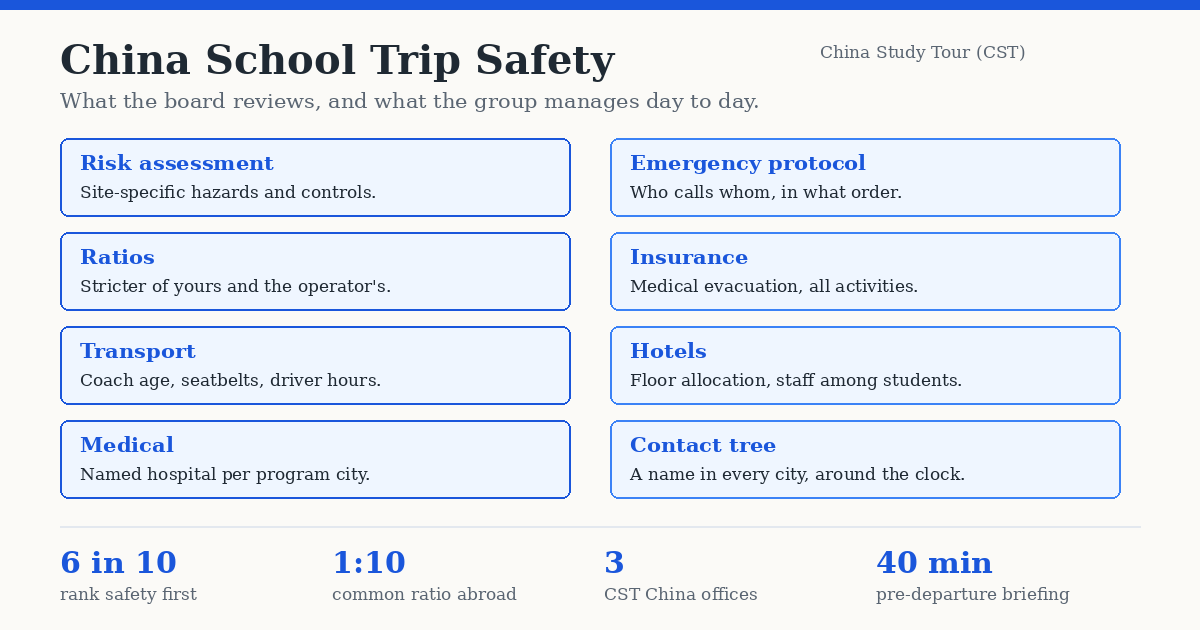
Most schools need board or governor approval, and most approvals stall on a missing document rather than on a real objection. Collect this set early and the meeting is short.
| Document | What it must actually contain | Common gap |
|---|---|---|
| Risk assessment. | Named hazards per activity, likelihood, control measures, residual risk. | A generic template with no site-specific entries. |
| Emergency protocol. | Who calls whom, in what order, with time targets and a reporting line home. | A phone number and nothing else. |
| Ratio guidance. | Staff-to-student ratios by age band, plus rules for splitting the group. | Silence on what happens when the group divides. |
| Insurance requirements. | Minimum coverage, medical evacuation, and the activities included. | Cover that excludes a listed activity. |
| Hotel safety details. | Named properties, floor allocation logic, fire exits, staff on site overnight. | Hotels described only by star rating. |
| Transport details. | Licensed operator, coach age, seatbelts, driver hours. | Coach specifics left until arrival. |
| Contact tree. | Named in-country contacts per city, reachable around the clock. | One office number in a single time zone. |
Ask for the whole pack in one request. The speed of the reply tells you as much as the contents, because an operator that has to assemble it is assembling it for the first time.
Supervision, ratios and the moments groups lose students
Ratios are set by your own authority, and they differ by country and age band. Take your rule and the operator's guidance, then apply the stricter one. Common practice for secondary groups traveling abroad is around one adult per ten students, with at least two staff. The composition of the group usually decides the rest.
Where students actually separate
Losses happen at transitions, not at sites. The high-risk moments are the same on every trip: leaving a subway platform, exiting a crowded landmark, boarding a coach in a busy parking area, and moving through a train station. Count at every transition and count aloud. Chinese railway stations are large, and a group of thirty can stretch across two carriages before anyone notices.
Free time rules
Older students want unsupervised time, and there is a workable version of it. Set a small-group minimum of three, a fixed return point, a written time, and a rule that everyone carries the hotel card in Chinese. Agree in advance what a student does when their phone dies, because that is the scenario that turns a late return into an incident.
Transport, hotels and food
Coaches deserve a written answer rather than a verbal one. Ask for the operator's license, the vehicle age and confirmation that seatbelts are fitted and used. Older coaches remain in service in some cities, and the answer should be specific to the vehicle your group will actually ride in.
Hotels are usually the easiest part. Ask for students to be placed on the same floor or in adjacent blocks, with staff rooms among them rather than on another level. Confirm that at least one member of the hotel's overnight staff can be reached in English, or that the guide stays in the same property.
Food is the most common cause of a lost half day. Have every allergy written in Chinese on a card that the student carries, and give a copy to the guide. Vegetarian, halal and gluten-free requirements are all workable in the program cities, provided the operator knows before the restaurant is booked. Set a clear rule on street food, and make bottled water the default.
Medical cover and what happens when a student is ill
Insurance comes first, because it decides what is possible later. Require comprehensive travel insurance including medical evacuation for every participant. Confirm that it covers each activity on the itinerary, and check the excess your families would face.
Major hospitals in Beijing, Shanghai and Shenzhen run international departments with English-speaking staff and direct billing arrangements. Ask the operator to name the designated facility for each city in the pack, so nobody is searching for one at midnight. Students on prescription medication should carry it in the original labeled packaging, with a copy of the prescription. The lead teacher holds a written list of who takes what.
Heat is the seasonal risk people underestimate. July and August are hot in Beijing and Shanghai, which is one reason the school trips to China calendar favors spring and autumn for student groups.
Phones, apps and staying reachable
Set up communication before departure rather than in the arrivals hall. A group chat that every adult joins is the practical backbone, and Chinese hosts confirm changes there faster than by email. Students need a translation app, an offline map, the hotel card in Chinese, and the lead teacher's number written on paper.
International roaming works normally. Some familiar apps and sites are not reachable on local networks, so brief students and parents on what will and will not work before the trip, and agree how families will hear from students during the week.
The incident protocol, in order
Every operator should be able to state this sequence without looking it up. If yours cannot, that is the finding.
First, the group stops and the students are accounted for. Second, the guide calls the local office, which is in the same city and the same time zone. Third, the designated hospital or the relevant authority is contacted, with the guide present to interpret. Fourth, the lead teacher informs the school's emergency contact at home, using the reporting line agreed before departure. Fifth, everything is written down while it is fresh, because the incident report is what your insurer and your board will read.
Agree one more thing in advance: who speaks to parents, and who speaks to nobody. A single named person at school should handle family communication, so that a partial account does not travel faster than the facts.
Corporate campuses clear visitors against a list submitted days in advance, and reception checks the physical passport on arrival. That is also why access runs through pre-vetted partners rather than direct email, and why a late name substitution can mean re-running clearance for that student. CST's access rests on 13+ years of partner relationships, and the passenger list is part of it.
What to verify yourself before departure
Three things are worth checking personally, however good the operator is. Confirm that every passport has the validity your airline and destination require, and that names match the tickets exactly. Entry requirements differ by passport, and they are set out under China visa for school groups. Confirm that the insurance certificate names each participant or the group correctly. Confirm that your copy of the itinerary matches the one the guide is carrying. Late changes are the usual source of a day-one mismatch.
Then run a short pre-departure briefing for students and one for parents. Cover the ratio rules, the free-time rules and the food and water rules. Then cover what to do if separated, and who to call. The briefing takes forty minutes and removes most of the incidents that would otherwise happen in week one. Sample structures for both sit on the school trip planning guide.
Frequently asked questions
Is China safe for a secondary school group?
Major Chinese cities report lower violent-crime rates than most large cities in Europe and North America, and student groups have traveled there routinely for years. The realistic risks are ordinary travel risks: heat, traffic, stomach upsets and separation in crowds. Each is manageable with rules agreed before departure.
What documents do we need for board approval?
Risk assessments, an emergency protocol, staff-to-student ratio guidance, insurance requirements, hotel safety details, transport details and a named contact tree. Request them as one pack during selection. An operator that runs student groups regularly keeps the set ready for submission.
What staff-to-student ratio should we use in China?
Use whichever is stricter between your own authority's rule and the operator's guidance. Common practice for secondary groups abroad is roughly one adult per ten students with a minimum of two staff. Agree separately what the ratio becomes when the group splits for different activities.
What medical support is available if a student gets ill?
Major hospitals in Beijing, Shanghai and Shenzhen have international departments with English-speaking staff. Ask your operator to name the designated facility per city in advance, require insurance with medical evacuation, and keep prescription medication in original labeled packaging with a copy of the prescription.
Who is responsible for the group on the ground?
The lead teacher keeps duty of care for the students throughout. The operator is responsible for logistics, local risk control and the emergency response, which is why in-country offices matter. Ask for a named contact in each city your group will sleep in, reachable around the clock.
Can we get China school trip safety documentation before we commit?
Yes, and you should. CST provides the full pack on request during planning, and works in English, Chinese, Spanish, Portuguese, and Japanese. All guides are bilingual, and additional language support is available upon request.
Get the safeguarding pack for your group
Send your dates, group size and year group. You get risk assessments, the emergency protocol, ratio guidance and insurance requirements, ready for board submission.
Request the safety pack