China Business Etiquette: 10 Tips for Executive Visitors
China business etiquette places strong emphasis on hierarchy, relationship-building, and formal introductions. For an executive on a first visit, small signals carry real weight: who you greet first, how you hand over a business card and where you sit at dinner. Here are 10 practical tips for executives preparing for their first China business trip, followed by a pre-trip checklist and a simple guide to meetings and dinners.
Business etiquette in China places strong emphasis on hierarchy, relationship-building, and formal introductions. In practice, greet the most senior person first, exchange two-sided business cards with both hands, let the host lead at dinner and never correct anyone in public. Most mistakes can be repaired if you handle them quickly and privately.
Key Takeaways
- Hierarchy first. Greet, seat and address the most senior person first, using title and surname.
- Face matters. Praise in public and raise problems in private, including with your own team.
- Prepare before you fly. Two-sided business cards, WeChat and mobile payment remove most avoidable friction.
- Dinner is part of the meeting. Relationships, and often decisions, move forward at the table.
- Confirm in writing. Read "we will study it" as a maybe, and send a written summary within 24 hours.
Why China Business Etiquette Matters for Executives
In many Western companies, the deal comes first and the relationship follows. In China, the order is often reversed. The relationship, known as guanxi (关系), comes first. The contract then records what both sides already trust each other to do.
Three ideas shape most meetings. First, seniority is visible in who speaks, who sits where and who is greeted first. Second, face (mianzi, 面子) is protected for everyone in the room. Third, trust builds slowly and is tested through small promises. China Study Tour (CST) has arranged executive meetings in China since 2013. In our experience, the visitors who gain the most do not memorize rules. They show respect, ask informed questions and follow through.
Etiquette also varies by host. A private tech company in Shenzhen is often relaxed, while a state-owned enterprise in Beijing is usually more formal, with stricter rules on seating and gifts. Still, a missed greeting or a clumsy toast costs goodwill in both. The tips below cover where first-time executives most often slip.
10 China Business Etiquette Tips for Your First Visit
The tips follow the order of a real trip: before you fly, in the meeting room, at dinner and after you leave. Each one is short enough to read in the car on the way to a meeting.
Print two-sided business cards in Chinese and English
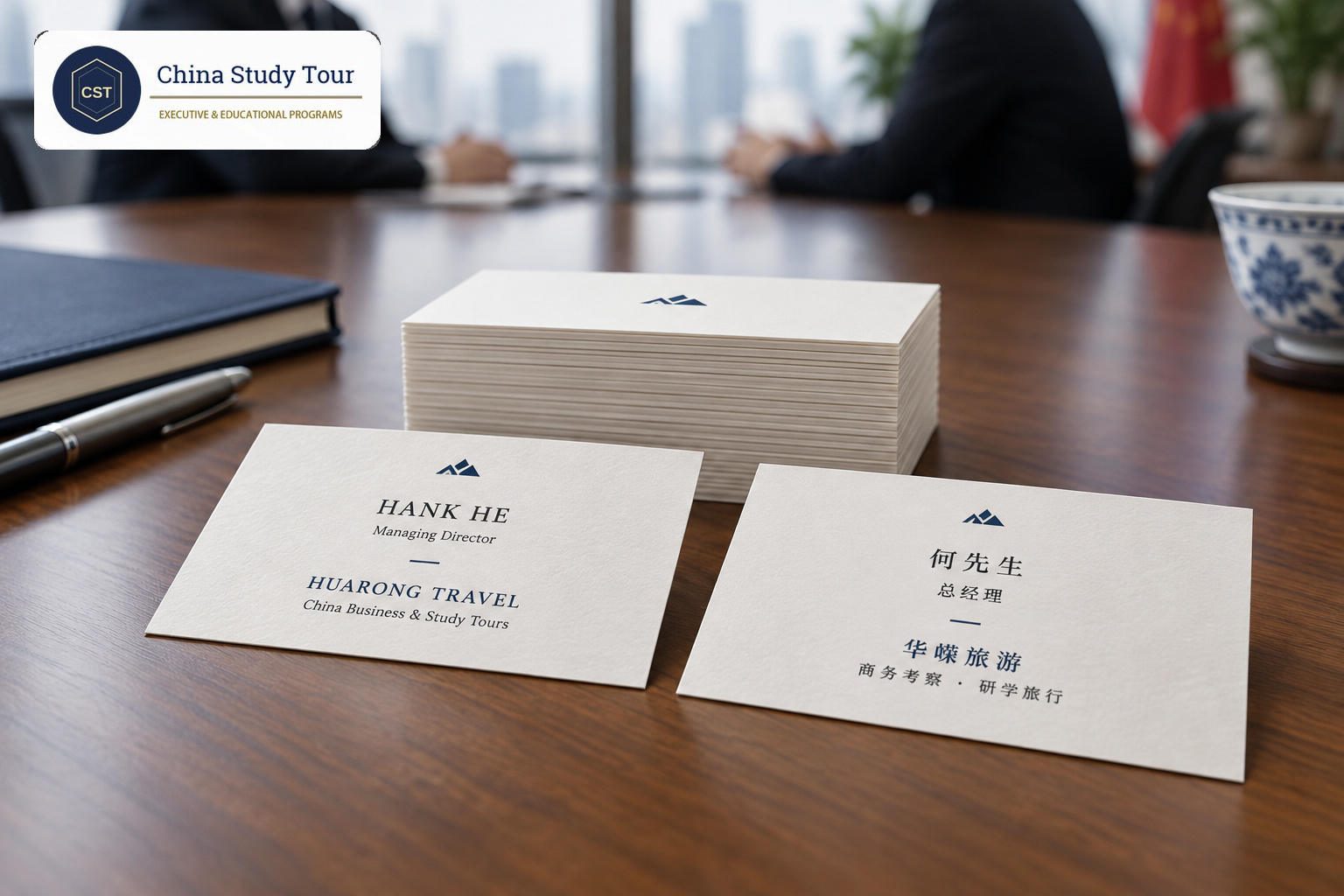
Your hosts may speak good English and still want to read your name, title and company in Chinese. A one-sided English card is often put away, while a two-sided card stays on the table during the meeting. Print 80 to 100 cards, or more for group introductions. Ask a native speaker to check the Chinese characters and your title translation before printing.
Bring a modest gift, and know what to avoid
A small gift for the host team is welcome on a first visit. Good choices include a specialty food from your home region, a book or quality company-branded items. Avoid clocks, which are linked with funerals, and knives or scissors, which suggest cutting ties. Also avoid sets of four, because four sounds like the word for death. Present the gift with both hands, and do not expect it to be opened in front of you.
Arrive 5 to 10 minutes early
Chinese hosts read punctuality as a sign of how seriously you take the meeting. Arriving even 10 minutes late starts the visit with a small loss of goodwill. Plan extra time for traffic, building security and visitor registration, especially in Beijing, Shanghai and Shenzhen. If a delay cannot be avoided, message your host as soon as you know. An early warning repairs most of the damage, but a silent late arrival does not.
Greet the most senior person first, by title and surname
Wait for your host to introduce the room. Then greet the most senior person first, with a handshake and a slight nod. Use the title and surname, such as "Chairman Wang" or "Director Li." Chinese names put the family name first, so Wang Wei is Mr. Wang. Keep first names for later in the relationship. If the group is large, ask your liaison beforehand who makes the final decision.
Give and receive business cards with both hands
Hold your card with both hands, Chinese side up and facing the receiver. When you receive a card, read it for two or three seconds and repeat the name or title. Then place it on the table in front of you, in the order people are seated. Do not write on it or put it in your back pocket. A simple card holder is one of the most useful items you can pack.
Allow 10 to 15 minutes of small talk before business
The first part of a meeting builds the relationship. Tea is poured, and the host may ask about your flight, the city or your family. Moving straight to the agenda can seem cold and transactional. Instead, let the host lead, ask a few follow-up questions and wait for a signal to start. This early talk often shapes how open the rest of the meeting will be.
Protect face: praise in public, raise concerns in private
Face (mianzi) is a person's standing and dignity in front of others. The rule is simple: praise publicly, raise problems privately, and never correct a senior person across the table. If something must be said, say it after the meeting, ideally through your interpreter or liaison. This applies to your own team too. Correcting a colleague in front of the hosts also costs you face.
At dinner, let the host lead and toast with your glass lower
Business dinners are part of the working relationship. The host orders for the table, seats the guests and signals when to start eating. Try a small amount of every dish. When you toast a senior person, hold your glass slightly lower than theirs and make eye contact. If you are unsure about a dish, ask what it is rather than leaving it untouched.
If you do not drink, give a health reason early
Baijiu, a strong grain spirit, is part of many banquet toasts. A flat refusal can feel like you are rejecting the host, not the drink. If you cannot or will not drink, give a short health reason early in the evening, such as medication. Then toast with tea, juice or warm water, with your glass held lower as usual. Most hosts accept this and stop pressing after a round or two.
Confirm next steps in writing, and read "we will study it" carefully
Before you leave, summarize the agreed next steps out loud. Then send a written summary within 24 hours, in English and Chinese if possible. Phrases such as "we will study it" or "let us think about it" often mean a delay or a polite no, not a yes. Ask one polite clarifying question, agree on a follow-up date and record it in writing.
Etiquette cheat sheet: do and don't
| Stage | Do | Don't |
|---|---|---|
| Before the trip | Print 80 to 100 two-sided cards. Set up WeChat and mobile payment one week before you fly. | Print cards at the last minute, rely only on email, or arrive without reading about your host. |
| Meeting | Arrive 5 to 10 minutes early. Greet the most senior person first. Confirm next steps before leaving. | Correct a senior person in public, skip the small talk, or treat "we will study it" as a yes. |
| Dinner | Let the host lead. Try every dish. Toast with your glass lower than the senior person's glass. | Refuse a toast with no reason, raise politics, or fight for the bill as a guest. |
| After | Send a WeChat thank-you the same day and a written summary by email within 24 hours. | Go silent for weeks, or change agreed terms without a call first. |
Before Your Trip: Prep Checklist
Most avoidable friction happens in the week before you fly, not in the meeting room. Run through this list 5 to 7 working days before departure. Start visa checks much earlier.
- Business cards: 80 to 100 two-sided cards, with the Chinese checked by a native speaker.
- WeChat: set up and verify your account before you leave. Hosts use it to share addresses, confirm times and stay in touch.
- Mobile payment: link an international Visa or Mastercard to Alipay or WeChat Pay. Carry some RMB cash as a backup.
- Translation app: install one that works offline. Also prepare a one-page company brief in English and Chinese.
- Addresses in Chinese: write every meeting address in Chinese characters, ready to show a taxi driver or hotel staff.
- Time between meetings: keep at least 30 minutes between appointments for traffic and security checks.
- Hotel location: on the first night, stay close to the first meeting. A short walk is better than an hour in city traffic.
- Gift for the host team: wrapped, modest in value and, if possible, from your home region.
- Research on your host: read the last six months of company news, recent leadership changes and recent deals.
- Visa and invitation letter: check entry rules 6 to 8 weeks before travel. As of October 2026, many nationalities can enter visa-free for up to 30 days under a policy that runs to December 31, 2026, according to China's official notice on the visa-free extension. Others need an M (business) visa. See our visa-free business travel guide and China business visa guide.
A note on gift giving in Chinese business
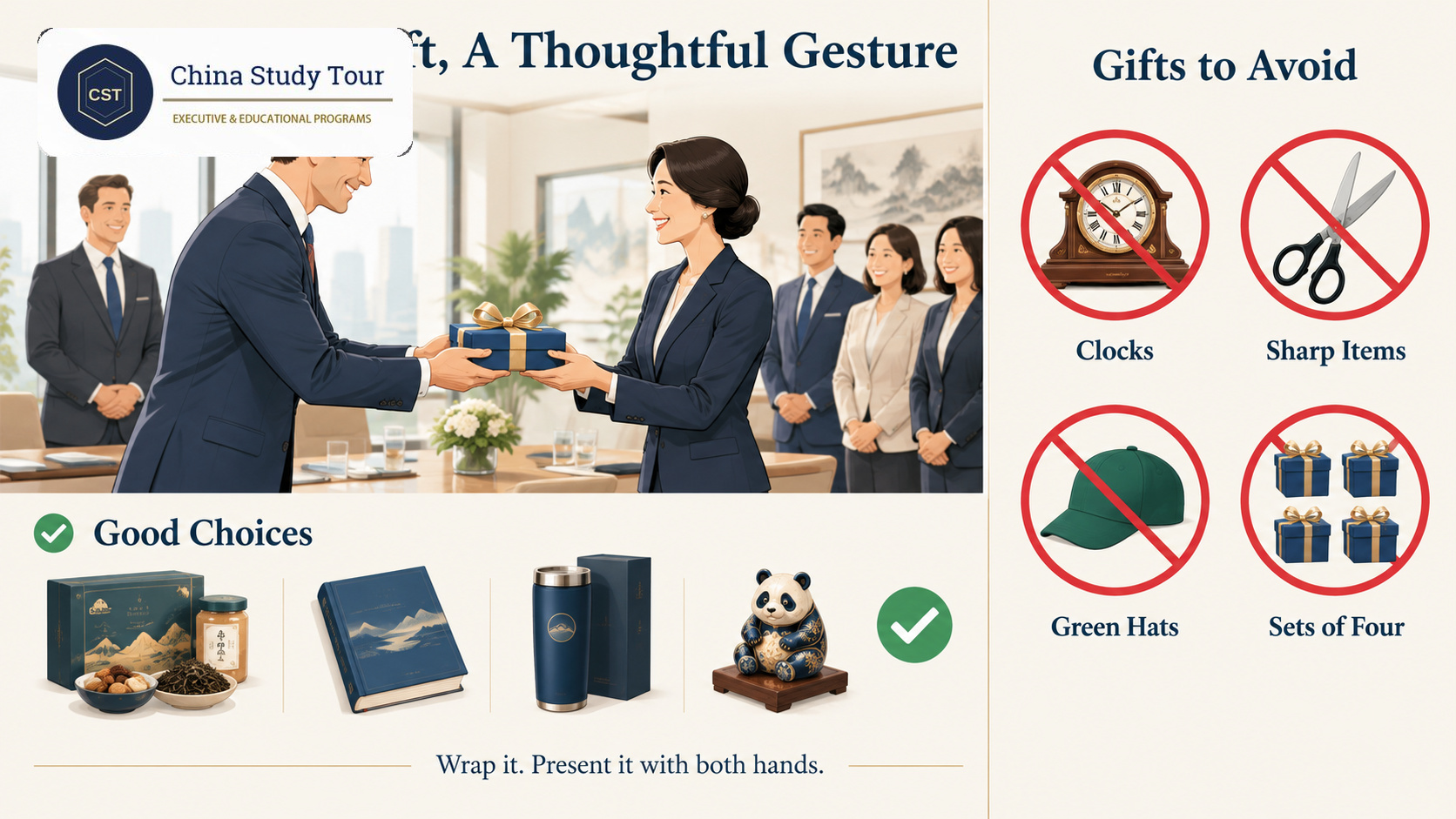
Gift giving in China is about the gesture, not the price. One gift for the host team, presented to the senior person, is safer than separate gifts for each individual. Red and gold wrapping is a good choice, while plain white or black can suggest mourning.
Your hosts also have rules. Managers at state-owned enterprises and government bodies work under strict limits on gifts and banquets. Some will politely decline a gift, even a small one. If that happens, accept the refusal with a smile and do not insist. The gesture has still been noticed.
At the Meeting: What to Expect
The meeting room is where China business etiquette is most visible. A first meeting with a Chinese company usually follows a clear pattern, and knowing it helps you relax and read the room.
- Arrival and seating. The host team meets you, often in the lobby, and shows you to the meeting room. Wait to be seated.
- Tea and small talk (10 to 15 minutes). The host leads. Cards are exchanged at this stage.
- Host presentation. Expect company history, scale and recent milestones, often longer than at home.
- Your presentation and discussion (40 to 60 minutes). Short sentences, clear numbers, pauses for translation.
- Close (about 10 minutes). Confirm next steps, agree on a follow-up date and exchange WeChat contacts.
The room often holds more people than visitors expect: the host's team, a note-taker and sometimes an interpreter. The senior host may arrive last or already be seated when you enter. Seating usually puts the two leaders facing each other, with each team arranged by rank.
During the discussion, speak in short sentences and pause for translation. Use concrete numbers rather than adjectives. Chinese executives respond well to specifics, such as capacity, timelines, certifications and named customers. For behavior on factory floors and in tech parks, see our China company visit guide.
At Dinner: Seating, Toasts and Topics
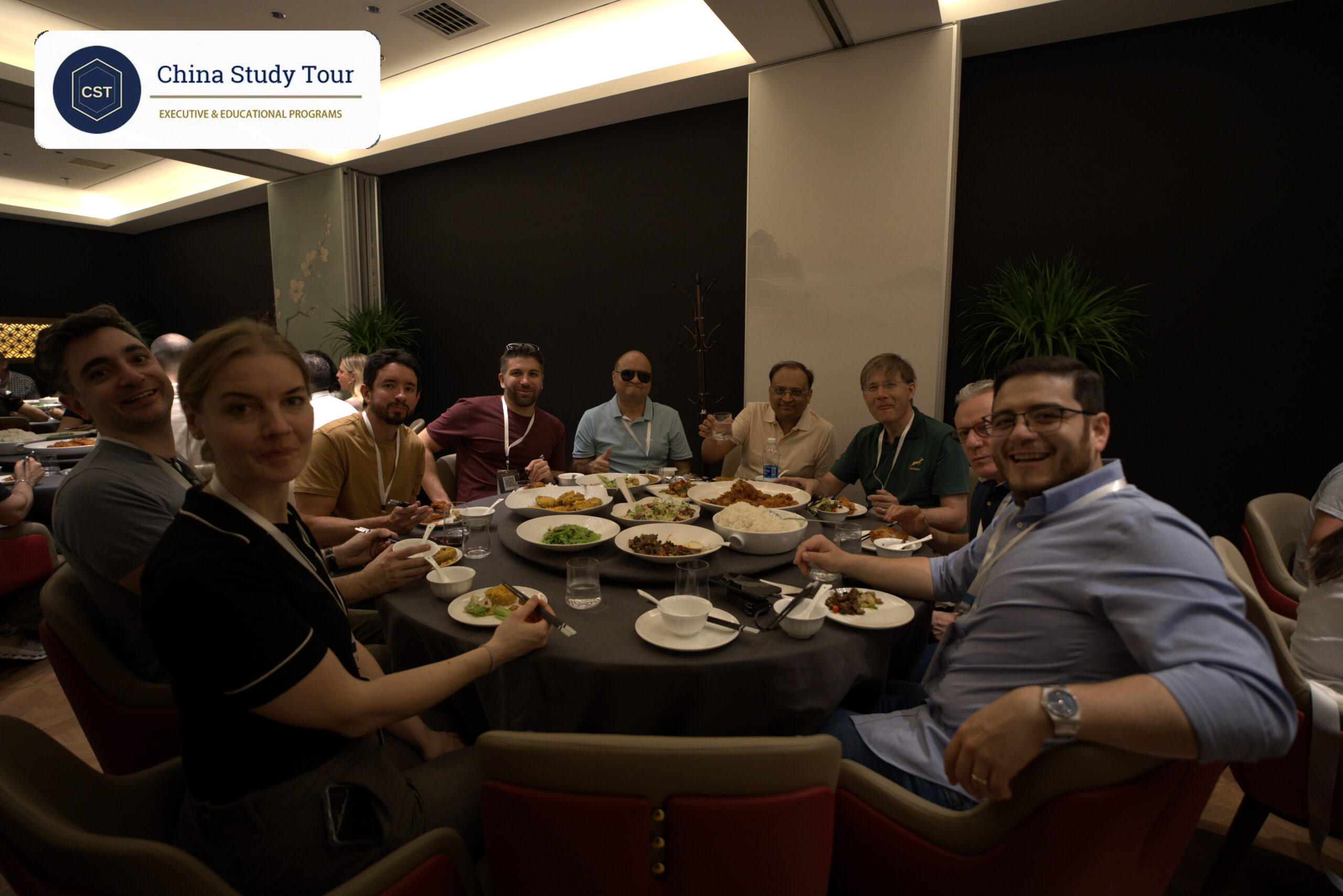
A Chinese business dinner is not a break from work. It is the same working relationship in a different room, and China business etiquette applies just as much here. Points that stayed open in the meeting often move forward over dinner.
Seating
Seats are assigned. The host usually sits facing the door, and the main guest sits on the host's right, the seat of honor. Wait to be shown your seat. The host orders for the table, and dishes are shared from the center. Serve your neighbor before yourself when you can.
Toasts
The senior host usually opens with a toast to the whole table early in the meal. Stand if others stand, and hold your glass lower than the senior person's glass. Eye contact matters more than volume. If you host a return dinner later in the trip, prepare a short toast in advance, ideally with one line in Chinese.
Conversation topics and the bill
Keep conversation light: travel, food, the city, family, sports and films. Avoid politics, including questions about Taiwan, Tibet, Xinjiang and Hong Kong, unless your host raises the subject. If a sensitive topic does come up, listen, do not argue a position and return to shared interests.
As a guest, do not fight for the bill. If you want to return the favor, invite the host team to your own dinner later in the trip.
Most etiquette problems happen in the gaps: who outranks whom, what a vague answer really means, or whether a gift fits the host's rules. When China Study Tour (CST) runs the trip, a bilingual program manager briefs your group on each host before the visit. The same manager joins a structured debrief after each meeting, so small signals are not missed.
This guide was written by the program team at China Study Tour (CST). It is based on the meetings and dinners our team has arranged for executive delegations since 2013, across 300+ programs. China business etiquette varies by company, city and generation, so treat these tips as a starting point, not fixed rules. Visa and payment details are a snapshot as of October 2026.
China Business Etiquette FAQ
Do I really need bilingual business cards in China?
Yes. Even hosts who speak fluent English will want to read your name, title and company in Chinese. A one-sided English card is easy to put away and forget. Print 80 to 100 two-sided cards, with Chinese on one side and English on the other, and ask a native speaker to check the characters before printing.
Is it rude to refuse alcohol at a Chinese business dinner?
A flat refusal can feel cold, but declining is acceptable if you explain early. Give a short health reason, such as medication, and toast with tea, juice or warm water. Hold your glass lower than the senior person's glass. Most hosts stop pressing after a round or two.
What should I do if I cause someone to lose face?
Act quickly and privately. After the meeting, offer a short, sincere apology, ideally through your interpreter or the host's liaison. Do not apologize in front of the whole group, because that draws more attention to the moment. In most cases, a private apology and a warm follow-up repair the relationship.
How do I handle gift giving if my company has a strict anti-bribery policy?
Keep gifts modest and clearly symbolic, such as a book, a regional food or company-branded items. Many companies set an internal limit of around US$50, but that is a company rule, not a legal threshold. Never give cash or gift cards. Some state-owned hosts must decline gifts, so do not insist.
Should I follow up on WeChat or by email?
Use both. Send a short WeChat message the same day to thank your host and confirm one key point. Then send a formal email within 24 hours that lists the agreed next steps. Email is the record that colleagues can forward, while WeChat keeps the personal connection warm.
China Study Tour (CST) has designed executive programs in China since 2013, with offices in Beijing, Shanghai and Shenzhen. Each program is built around your sector, your target companies and your timeline. Our guides work in English, Chinese, Spanish, Portuguese, and Japanese. All guides are bilingual, and additional language support is available upon request.
Explore the Executive Study Tour Guide → Get a Custom Proposal in 24 Hours →
Email: info@chinastudytour.ai·WhatsApp / WeChat: +86 131 6180 6706