
China Business Visa 2026: Who Still Needs to Apply
A China business visa is no longer the default. Fifty nationalities now enter visa-free. Here is how to tell whether your delegation still needs one, which category fits a study tour, and what the invitation letter has to say.
- 🛂 M visa, F visa or visa-free
- 🌍 50 countries visa-free for 30 days
- 📄 Invitation letter from the host
- ⏱ 4 business days standard
- 📅 Start 6–8 weeks out
- 🪪 Digital arrival card required
- ✍ Updated September 2026
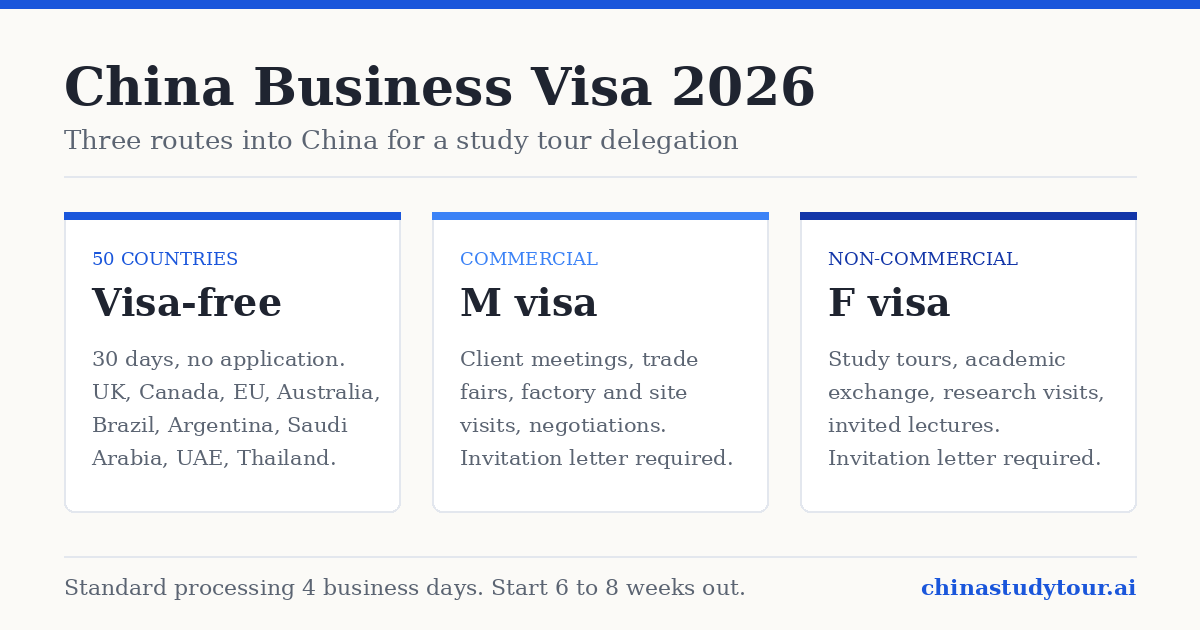
Most delegates on a study tour no longer need a China business visa. Ordinary passport holders from 50 countries can enter visa-free for up to 30 days, and business meetings and exchange visits are covered purposes. If your passport is not on that list, you need an M visa for commercial visits or an F visa for non-commercial study tours, plus an invitation letter from your host in China. Standard processing runs four business days, and CST recommends starting six to eight weeks before departure.
Key takeaways
- Check the nationality table first. Half of CST's key markets are now visa-free for 30 days.
- The category follows what the group actually does in China, not what the trip is called.
- Every applicant needs an invitation letter with the host's official seal. CST issues it once the program is confirmed.
- Visa-free entry is capped at 30 days and does not cover work, study or journalism.
- Carry the invitation letter and hotel bookings even when you travel visa-free.
Do you need a China business visa at all?
Start here, because for roughly half our delegates the answer is no. China has widened its unilateral visa-free policy every few months since December 2023, and 50 countries are now on it. Canada and the United Kingdom were added on February 17, 2026, which caught a lot of program managers out.
Ordinary passport holders from those countries stay up to 30 days. The permitted purposes are business, tourism, family and friend visits, exchanges, and transit, so a week of company briefings sits comfortably inside the policy. It currently runs to December 31, 2026.
Running alongside it are mutual visa exemption agreements covering ordinary passports from 29 countries, among them the United Arab Emirates, Thailand, Singapore, Malaysia and Qatar. Those are treaties rather than policy, so no expiry date is attached.
Visa-free or visa required, by passport
Check every delegate against this before anyone opens a form.
| Passport | Status for a 7-day study tour | What to do |
|---|---|---|
| United Kingdom | Visa-free, 30 days, since February 17, 2026 | Travel on your passport. Carry the invitation letter. |
| Canada | Visa-free, 30 days, since February 17, 2026 | Travel on your passport. Carry the invitation letter. |
| Spain and most of the EU | Visa-free, 30 days, from December 2023 onward | Travel on your passport. Carry the invitation letter. |
| Australia | Visa-free, 30 days, since July 1, 2024 | Travel on your passport. Carry the invitation letter. |
| Brazil and Argentina | Visa-free, 30 days, since June 1, 2025 | Travel on your passport. Carry the invitation letter. |
| Saudi Arabia | Visa-free, 30 days, since June 9, 2025 | Travel on your passport. Carry the invitation letter. |
| United Arab Emirates | Visa-free under a mutual exemption agreement | Travel on your passport. Carry the invitation letter. |
| Thailand | Visa-free under a mutual exemption agreement | Travel on your passport. Carry the invitation letter. |
Markets that still file an application
| Passport | Status for a 7-day study tour | What to do |
|---|---|---|
| United States | Visa required | Apply for M or F. The 240-hour transit rule only helps if you fly on to a third country. |
| India | Visa required | Apply for M or F at the visa center serving your state. |
| South Africa | Visa required | Apply for M or F. |
| Egypt | Visa required | Apply for M or F. |
| Türkiye | Not on either published list. Sources disagree. | Plan for a visa and confirm with your consulate before booking. |
Nationality is what counts here, not where somebody lives. A group of twelve routinely splits into eight who fly on their passports and four who file applications, and the four decide your timeline. Verify current status against the National Immigration Administration, or a maintained summary such as the China Briefing visa-free policy guide, before you lock dates.
What visa-free entry does not cover
The exemption is narrower than the headlines suggest. It stops at 30 days per entry. It excludes work, study, journalism and anything else needing prior approval. And immigration officers can still ask a visa-free arrival to show what they came for, which is why we send the invitation letter to every delegate regardless of passport.
M visa or F visa
Two categories matter for a delegation, and China separates them by purpose:
- M visa. Commercial and trade activity. Client meetings, negotiations, trade fairs, factory and site visits.
- F visa. Exchanges, visits, study tours and other non-commercial activity. Academic exchange, research visits, invited lectures.
What decides this is the content of the week, not the words on your brochure. A corporate delegation touring manufacturers and sitting down with executives is doing commercial activity, so M is correct even when the trip is sold internally as a study tour. A university cohort observing classes and meeting faculty is doing exchange, so F fits. Filing under the wrong one is among the more common causes of refusal, and the invitation letter has to describe the same purpose the form declares.
Two neighboring categories are worth knowing so nobody reaches for them. L is tourism and Z is employment. Neither suits a delegation, and neither should be used to make a file look simpler than it is.
How long the visa is good for
Three separate numbers appear on the visa sticker, and mixing them up causes more overstays than any other single misunderstanding.
- Entries. Printed as 01, 02 or M. This is how many times you may cross the border.
- Enter Before. The last date you may arrive. It is not how long you may stay.
- Duration of Each Stay. Usually 30 or 60 days, counted from the day after entry.
Read together: a visa marked M / Enter Before 2036 / 60 days lets you arrive any number of times over ten years and stay two months per visit. Eligible US citizens are frequently issued exactly that. Delegates from other markets more often receive a single or double entry valid for three months, which is fine for one program and useless for the follow-up trip six months later.
Hong Kong and Macau use up an entry
Hong Kong and Macau run their own immigration control. A day trip from Shenzhen means leaving mainland China and coming back. On a single-entry visa that is the end of the visa, and the delegate is stranded on the wrong side of the boundary. Any program pairing Shenzhen or Guangzhou with Hong Kong needs double or multiple entry, and it has to be requested at application time rather than fixed later.
Since 2025, several provinces including Shanghai, Jiangsu and Liaoning have offered a five-year multiple-entry M visa with stays of up to 180 days, aimed at frequent business travelers. The Chinese host applies for it through the local Foreign Affairs Office, so it is worth raising with a partner you expect to visit repeatedly.
Documents required
Requirements shift a little between posts, and the visa center for your district publishes its own checklist. This set covers a standard application:
- Passport valid at least six months beyond entry, undamaged, with two blank visa pages
- Completed COVA online application form, printed and signed
- Recent color photograph to the Chinese passport photo specification
- Proof of legal residence if you apply outside your country of citizenship
- Round-trip flight booking and hotel reservations covering the full stay
- Invitation letter from the host organization in China
- Copy of any previous Chinese visa, or a signed explanation if you no longer hold it
- Fingerprints, collected in person, for applicants aged 14 to 70
Supporting business documents
Consulates sometimes ask for evidence behind the invitation, particularly for a first-time applicant or an unusually long stay. Have these ready rather than scrambling for them mid-application: trade fair or conference registration, a signed contract or purchase order with the Chinese party, and a copy of the inviting company's business license stamped with its official seal. We supply the last one with the letter.
What the invitation letter must contain
Every M and F application needs a letter from the inviting party in China. Consular officers read it closely, and a letter that is warm but vague is worth less than one that is dull and complete. It should carry:
- The applicant's full name exactly as printed in the passport, plus passport number, date of birth, gender and nationality
- The purpose of the visit, worded in the same category as the application
- Exact arrival and departure dates, and the cities on the itinerary
- A clear statement of who pays for accommodation, transport and living costs
- The inviting party's full name, address and telephone number
- The company seal, the signature of the legal representative, and the date of issue
Trade fairs are the one case where the letter does not have to come from a host company. Buyers who register on the official fair website can usually download an invitation letter issued by the organizer. Consulates accept it. A fair badge is not immigration permission, though, and the two documents get confused often enough to be worth separating in your briefing notes.
CST prepares the letter once your program and delegate list are confirmed, working from passport scans rather than a spreadsheet of names. Transliterated names are where this goes wrong. A middle name dropped in the letter but present in the passport has cost delegates a week, and the fix is always slower than the check.
Chinese firms issue invitation letters for visits they have already approved, and the leading companies accept outside visitors only through pre-vetted partners with verified credentials. Cold outreach rarely produces the visit, and without the visit there is no letter. CST's access rests on 13+ years of relationships, and the letter follows the confirmed booking rather than the other way around. See how it works for the full sequence.
How to apply, step by step
- Screen the passports. Run every delegate against the table above before anyone opens a form.
- Agree the category with your host. M or F, decided by what the group will actually do, and stated identically in the letter.
- File COVA online. The form goes for preliminary review and returns a confirmation page you print and sign.
- Book the appointment. In peak season, slots run out well before processing capacity does.
- Attend in person. Bring printed forms and originals. Fingerprints are taken at this step.
- Check the sticker before you leave. Name, entries, Enter Before date and duration of stay, in that order.
Processing time and fees
Four business days from submission is the standard at most Chinese visa application service centers and consulates. Express service, where a post offers it, returns the passport on the third business day. Mail applications in Australia run closer to ten working days, and any request for supplementary documents restarts the clock.
Fees are set per nationality and revised periodically, so the schedule published by the post serving you is the only figure worth quoting. As a reference point, US citizens currently pay $140 in consular fees for an M or F visa. Express adds $25 per visa and rush adds $37, under the fee notice in effect through December 31, 2026.
None of that includes the COVA pre-review, courier time, or the wait for an appointment. Six to eight weeks before departure is the sensible start for a group, which sits inside the eight to twelve weeks CST already asks for on company access. Book tighter than that and the visa stops being the constraint on your program, because company approval already is.
Applying as a group
Individual travelers and delegations hit different problems, and almost nothing written about the China business visa addresses the second. Four things reliably bite.
Consular districts split your group
Applications go to the post serving the applicant's address, so a delegation drawn from three states or three countries files in three places on three timetables. Map this in week one. It is the single most common reason a group's paperwork finishes late.
Passports leave the building for two weeks
Between submission and collection, nobody in your group holds their passport. That rules out other international travel in the window, and senior people need warning. We schedule the batch around known trips rather than discovering the conflict afterwards.
One refusal does not stop a program
If a delegate is refused or delayed, the program runs and that person joins later or is replaced. This is the practical argument for refundable bookings and an early start, not caution for its own sake. Where a file needs more documents, the post says what is missing and the clock restarts on resubmission.
Substitutions need a new letter
Swapping a delegate two weeks out means a fresh invitation letter with the new passport details, and a fresh application. Lock the list before the letters are issued, and tell us early when it changes.
The digital arrival card
Since November 20, 2025, every arriving foreign traveler completes an arrival card, and it is now filed online. This applies to visa-free arrivals as much as to visa holders, and most business-visa guides still do not mention it.
File it within 72 hours before arrival through the National Immigration Administration website, the NIA 12367 app, or the WeChat and Alipay mini programs. Submission returns a QR code. Screenshot it, because there is no phone signal in the immigration queue and your battery has just crossed the Pacific. One card per traveler, so a group of twenty produces twenty QR codes.
Two things worth knowing. The card is free, and the NIA has published warnings about sites that charge for it, so treat any payment page as a scam. And forgetting it is not a disaster: port QR codes, self-service kiosks and paper cards all still work, and nobody is refused entry for arriving without one. Details sit on the NIA arrival card notice.
Who we handle visa paperwork for
- Corporate delegations and executive teams
- Business schools, MBA and EMBA cohorts
- Universities, schools and research groups
- Government trade missions and industry associations
Why applications get refused
- The wrong category. A commercial itinerary filed as F, or an academic one filed as M, invites a second look nobody wants.
- An incomplete letter. Missing seal, missing signature, missing dates, or costs left unstated.
- Names that disagree. Passport, COVA form and invitation letter must match character for character.
- A passport with five months left. Six months beyond entry is the working standard. Check the whole group, not just the leader.
- A story that does not line up. Declared purpose, letter and itinerary should describe one trip.
- An earlier overstay or violation. Disclose it and explain it rather than hoping the file is clean.
- Leaving it to the last two weeks. Appointment availability, not processing speed, is usually what breaks a schedule.
Frequently Asked Questions
Do study tour participants still need a China business visa in 2026?
Many do not. Ordinary passport holders from 50 countries enter visa-free for up to 30 days, and business meetings and exchange visits are permitted purposes under that policy. Delegates from countries outside the list, including the United States and India, still apply for an M or F visa.
What is the difference between the M visa and the F visa?
The M visa covers commercial and trade activity such as client meetings, trade fairs and factory visits. The F visa covers exchanges, visits, study tours and other non-commercial activity. Your itinerary decides which applies, and the invitation letter must describe the same purpose.
How long does a China business visa take to process?
Four business days is the standard at most visa centers, with third-day express service at many posts. Add time for the COVA online pre-review, the appointment wait and courier delivery. Six to eight weeks before departure is a comfortable start for a group.
How much does a China business visa cost?
Fees are set per nationality and change periodically. US citizens currently pay $140 in consular fees for an M or F visa, with $25 for express and $37 for rush service under the notice running to December 31, 2026. Check the schedule published by the post serving your address.
How long can we stay on an M visa?
Read three fields on the sticker. Entries shows how many crossings you get, Enter Before is the last date you may arrive, and Duration of Each Stay is usually 30 or 60 days counted from the day after entry. Eligible US citizens often receive ten-year multiple-entry visas.
Who issues the invitation letter for a study tour?
The inviting party in China issues it, on letterhead, with an official seal and the legal representative's signature. CST prepares the letter once your program and delegate list are confirmed, using name spellings taken directly from passport scans.
Can our whole group apply together?
Applications are individual, though they are usually submitted as a batch through one appointment window. Delegates living in different consular districts have to apply at the post serving their address, which is what splits most group timelines. We schedule around that.
Do we need the digital arrival card if we travel visa-free?
Yes. Every arriving foreign traveler completes it, whatever their entry route. File it free through the National Immigration Administration channels within 72 hours before arrival and save the QR code as a screenshot. One card per person, and any site charging a fee for it is a scam.
What languages does CST support?
English, Chinese, Spanish, Portuguese, and Japanese. All guides are bilingual, and additional language support is available upon request. Visa document checklists are supplied in English by default.
Get Your Invitation Letter
Send your group size, nationalities and travel dates. We confirm which delegates need a visa, issue the invitation letter with the program, and reply within 24 hours.
Request an Invitation Letter →Email info@chinastudytour.ai · WhatsApp / WeChat +86 131 6180 6706
Related reading: Visa information · How it works · Baidu company visit · BYD company visit · Beijing guide · Contact