Guangzhou EV Factory Visit: XPeng, GAC and Software-Defined Vehicles
A Guangzhou EV factory visit lets a delegation compare two very different carmakers in one city. XPeng is a young electric vehicle maker that designs its own chips and software. It also opens its factories to visitors. GAC Group is a state-owned group that built cars with Toyota and Honda for two decades. Today it is rebuilding itself around its own brands, while those joint ventures shrink quickly.
Seeing both in the same week teaches more than either visit alone. That comparison is the main reason to plan a Guangzhou automotive study tour, rather than a general EV tour.
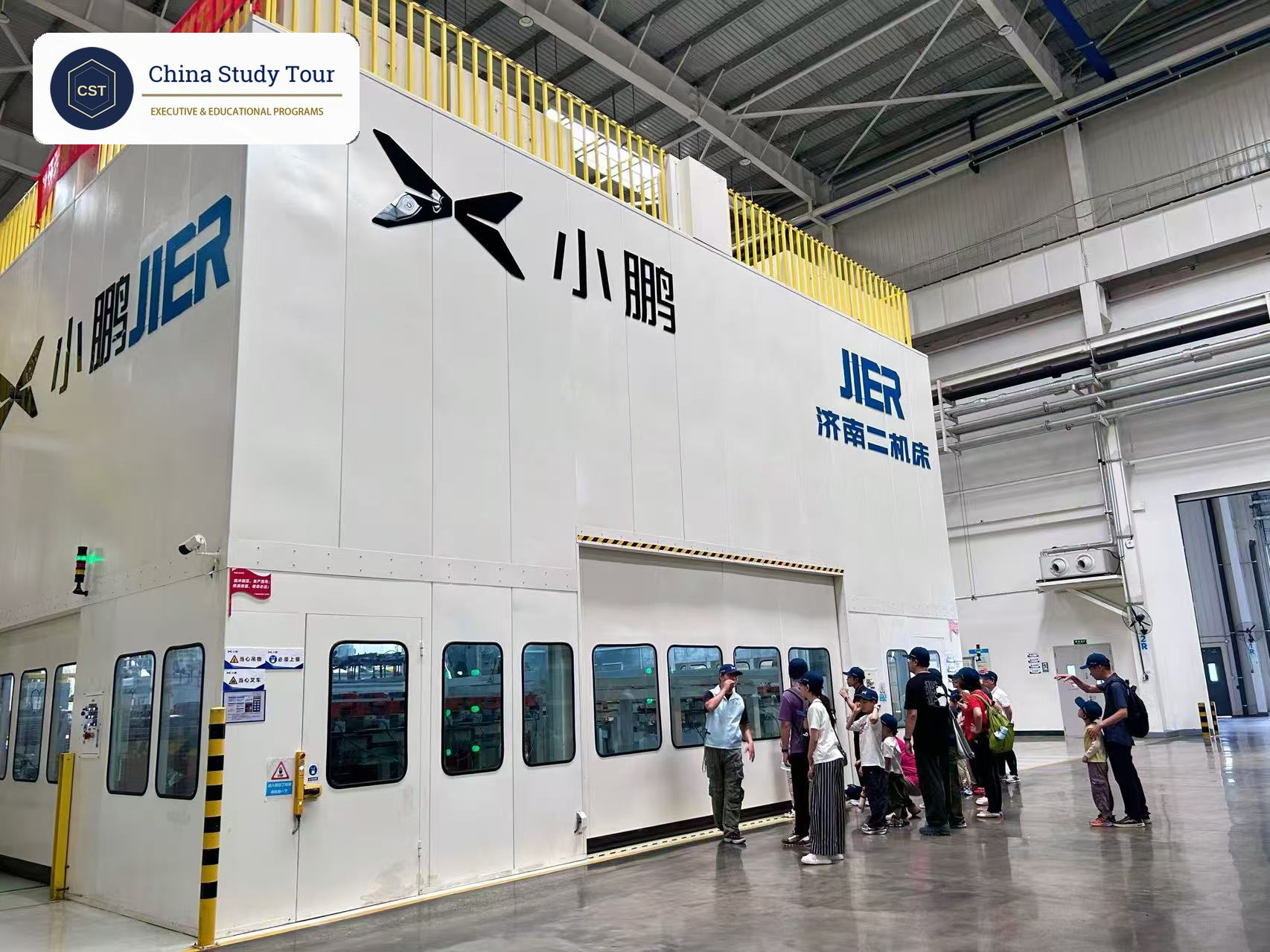
A Guangzhou EV factory visit usually pairs XPeng with GAC. At XPeng, you can visit its Guangzhou headquarters, its Guangzhou plant in Huangpu District and its Zhaoqing plant. At GAC, plant access is arranged for organized groups through partners such as China Study Tour (CST). Plan 8 to 12 weeks ahead for a program with named companies. For vehicles, the Canton Fair phase that matters is Phase 1, which runs October 15 to 19, 2026.
Key Takeaways
- XPeng opens three sites to visitors. Its AI Tech Manufacturing Tour opened on January 9, 2026, and covers the Guangzhou headquarters and the Guangzhou and Zhaoqing plants.
- GAC visits are arranged. Groups need an arranged visit with a stated business or learning purpose.
- The robot line stays closed. XPeng's IRON humanoid robot production line opened on September 8, 2026. It is not part of the visitor route.
- Software shows up in hardware. Look for the 16,000-tonne die-casting press, the 102-second assembly rhythm, AI vision inspection and over-the-air (OTA) software updates.
- GAC is the stronger case study for most incumbents. In September 2026 its own brands outsold its Toyota and Honda joint ventures combined, and exports rose 138.9% in nine months.
Why Guangzhou Works for a Two-Company Comparison
Most EV delegations go to Shenzhen, and for good reason. BYD has its headquarters there, and the supply chain is dense. However, Shenzhen mainly shows one company's answer at very large scale. Guangzhou shows two answers side by side, and comparison is where benchmarking really happens.
The city is also growing its EV base. According to Guangzhou's 2025 statistical bulletin, new energy vehicle (NEV) output rose 21.6% in 2025. Output of lithium-ion batteries rose 68.8%, and charger output rose 47.3%.
Within that cluster sit two companies with very different results. XPeng delivered 41,256 vehicles in September 2026, up 5% on August. Its third-quarter deliveries reached 118,390, up 15% on the second quarter. GAC Group sold 1,141,237 vehicles in the first nine months of 2026, down 3.58%. Yet its own brands are growing fast, and in September they finally overtook the joint ventures.
What a Guangzhou EV Factory Visit Includes
A well-built Guangzhou EV factory visit has four parts. Delegations often skip the fourth, which is a mistake.
- Brand and technology hall. The company explains its product line, platform and software roadmap. This part is useful, but much of it is also available in a showroom.
- Production floor. Stamping, welding, final assembly and, increasingly, the die-casting cell. Here, cycle time, automation and quality checks become visible facts rather than claims.
- Technical or management session. Engineers or managers answer your questions in a meeting room. This is the part that leads to decisions.
- Structured debrief. A short, guided review on the same evening, before fatigue erases the details.
Photo rules differ by site. Production areas often restrict photos, and some technical sessions ask for signed confidentiality terms. Staff check identity documents at the gate. Therefore, a delegation list with passport details is required, not optional.
Access: Which Sites You Can Visit
Many English-language pages mix up what each site shows. XPeng opens three sites to visitors, while its robot line stays closed. GAC plant visits are arranged for organized groups only, and the GAC plant in Panyu is about 40 minutes by car from the Canton Fair complex.
| Site | What you see |
|---|---|
| XPeng global headquarters, Guangzhou | AI mobility experience center, flying car gallery and flagship store |
| XPeng Guangzhou plant, Huangpu District | Vehicle production, the 16,000-tonne die-casting press, AI vision inspection and a flying car production zone |
| XPeng Zhaoqing plant | Volume production of models such as the MONA M03, about one car every 120 seconds |
| XPeng IRON robot production line | The humanoid robot line that opened on September 8, 2026. Not open to visitors. |
| GAC plant, Panyu District | Smart digital assembly workshop, welding shop and the Trumpchi showroom |
| GAC Craftsman Academy | Skills training ground with EV battery, motor and control training rigs |
| GAC Aion | GAC's EV brand and its own production |
| GAC Science and Technology Museum, Nansha | Group history, electrification and future mobility displays |
Why Partners Control GAC Access
GAC and other leading Chinese manufacturers accept outside groups through vetted partners with verified credentials. Cold emails from abroad rarely get a reply, and almost never a technical host. CST's access rests on more than 13 years of relationships in China, not on a contact list. The same is true for engineer sessions at XPeng: a site visit covers the route, not a meeting.
A robot demonstration in a showroom and the line that builds the robot are different things, with different access. The first is open to visitors. The second is not. This difference causes more confusion than any other point in Guangzhou.
XPeng: The Full-Stack Approach
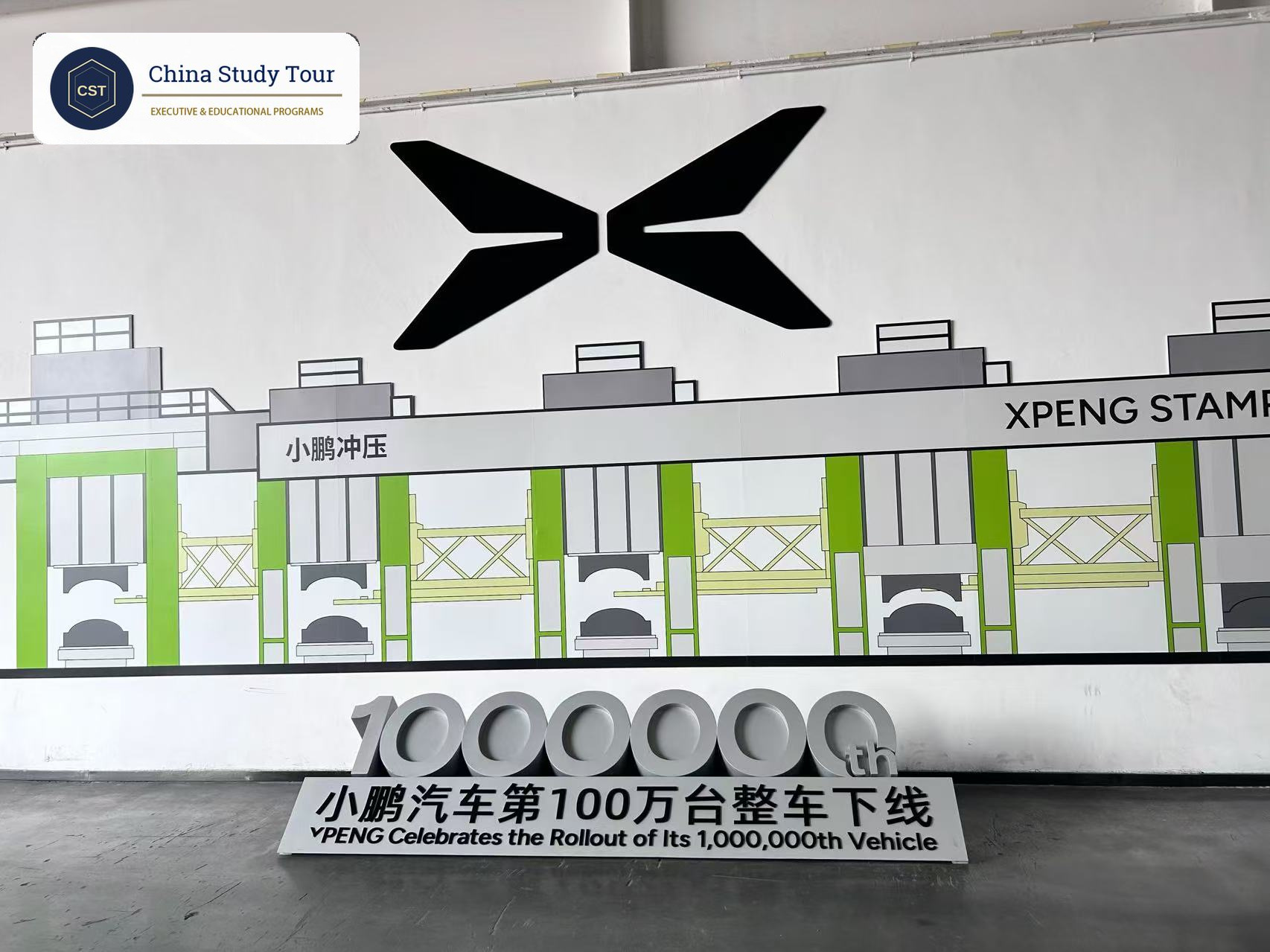
XPeng is the clearer story of the two, and the easier one to see. The company was founded in 2014 and is listed in Hong Kong and New York. It develops its own AI chip, its own vehicle operating system and, more and more, its own robots and flying cars. In January 2026 it marked its one-millionth vehicle off the line.
What the Guangzhou Plant Shows
At the Huangpu plant, three things are worth standing in front of. First, the 16,000-tonne die-casting press forms 167 separate parts in one shot. As a result, a large section of the car body is one piece instead of an assembly. Second, AI vision inspection runs across the whole process. At the panoramic roof station, a laser-guided robot holds assembly error within 0.05 mm. Third, a new car leaves the line about every 102 seconds, a figure shown on Guangdong state television in September 2026.
That 102-second number is the one to write down. It is the physical result of years of process work. It is also directly comparable to whatever your own plants run.
The Software Layer
XPeng designs its own Turing AI chip for its cars, robots and flying vehicles. On September 22, 2026, it began sending XOS 6.3.0 to cars in China. This software update runs the company's second-generation vision-language-action model, called VLA 2.0. The G9L flagship SUV launched in China on September 17, 2026, with a global launch in Paris planned for October. Then, on October 8, 2026, XPeng named its robotaxi business XPENG YOYO and launched a ride-hailing mini program.
Charging is part of the product, not an extra. As of September 30, 2026, XPeng's own network covered more than 430 cities in China. It had over 4,000 stations, including more than 3,510 ultra-fast stations, and over 22,200 chargers.
Taken together, XPeng argues that the car is a computer on wheels. Whether you agree matters less than seeing that argument built into a production line.
GAC: A State-Owned Group in Transition
For most delegations, GAC is the more useful visit, although it is harder to read. The headline number looks weak. Group sales fell 3.58% in the first nine months of 2026, and September sales fell 25.72% year on year. Below the headline, however, the structure is changing fast.
Here is what GAC's production and sales report for September 2026 shows:
| Line | September 2026 | January to September 2026 |
|---|---|---|
| Group total sales | 128,634 (down 25.72%) | 1,141,237 (down 3.58%) |
| New energy vehicles | 64,231 (up 50.90%) | 432,390 (up 61.13%) |
| GAC Aion | 39,667 (up 45.32%) | 283,747 (up 56.41%) |
| GAC Trumpchi | 27,478 (down 23.84%) | 241,174 (up 3.47%) |
| GAC Toyota | 54,800 (down 28.37%) | 510,000 (down 6.11%) |
| GAC Honda | 4,588 (down 86.02%) | 96,672 (down 56.82%) |
| Aistaland (GAC and Huawei brand) | 1,375 | 5,133 |
| Exports | 25,693 from own brands (up 160.9%) | 197,701 (up 138.9%) |
Two points stand out. First, GAC's own brands sold 68,520 vehicles in September, or 53.27% of group volume. That put them 9,132 units ahead of GAC Toyota and GAC Honda combined. Second, exports have become a real second engine. Growth has stayed above 100% for nine months in a row, and a kit assembly plant in Cambodia started production on September 17, 2026.
What a Delegation Saw at GAC in September 2026
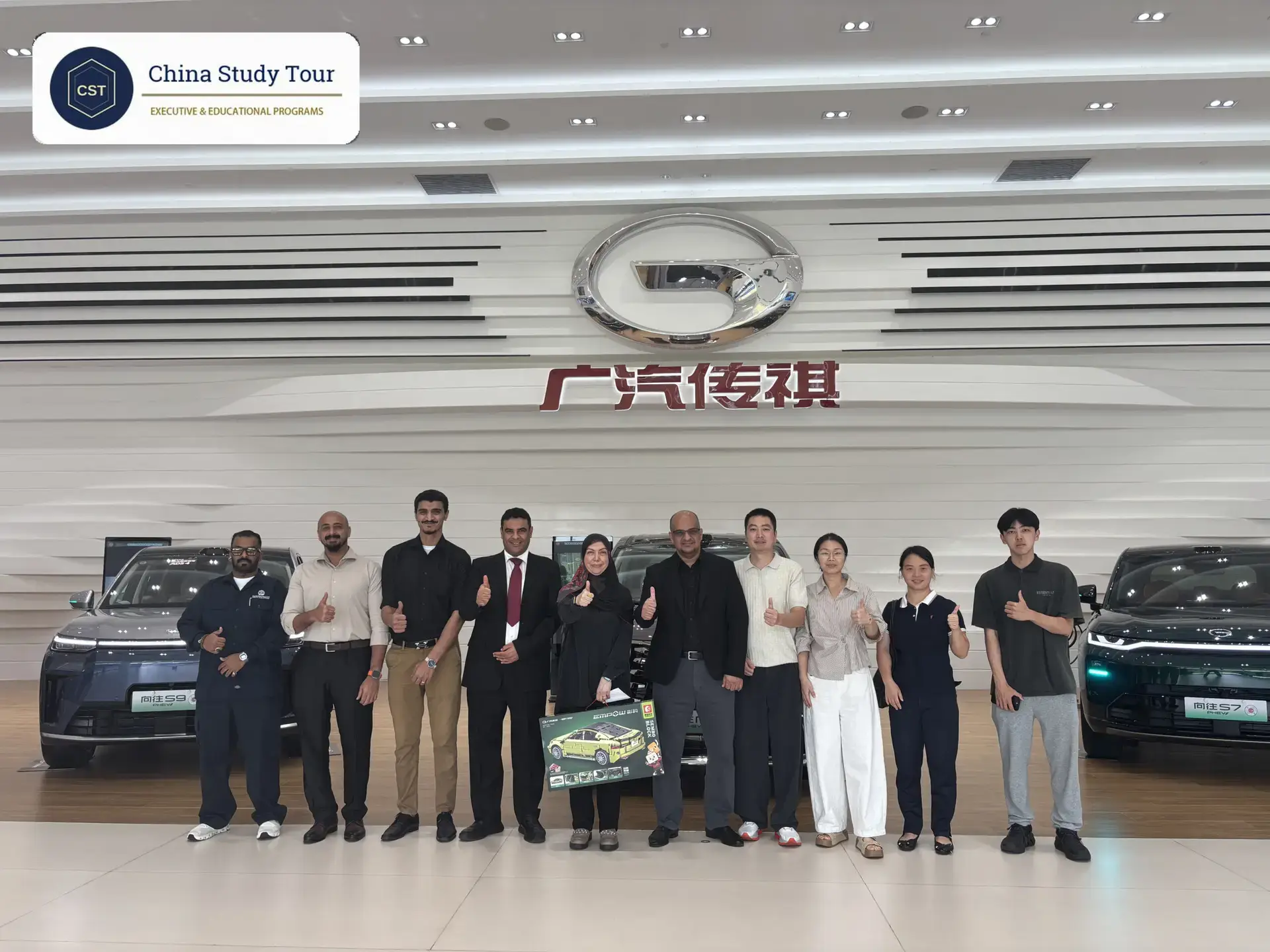
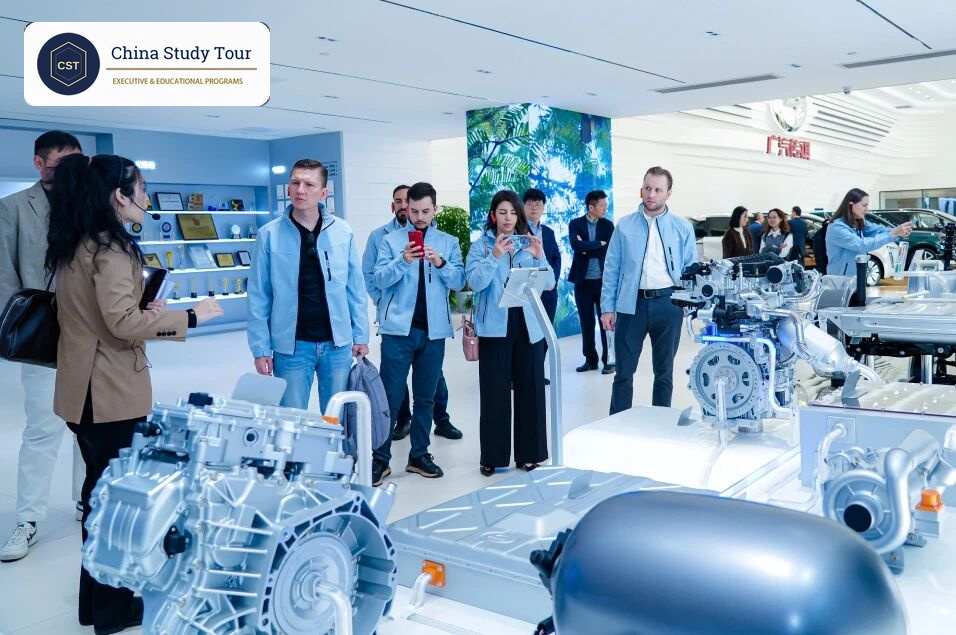
CST arranged a GAC visit for a Saudi training institution in September 2026. The visit took about three hours. The group walked the smart digital assembly workshop and the welding shop. Next, they toured the GAC Craftsman Academy, which trains the plant workforce on EV battery, motor and control rigs. A session with GAC training specialists followed, and the Trumpchi showroom came last. Engine production was dropped for time.
The useful details were small ones. Robots fit the windshields, while shock absorber bolts and interior wiring are still done by hand. In addition, any worker can stop the line when something looks wrong. The full report is in our GAC company visit with a Saudi delegation.
The Partner Software Route
GAC's software story runs partly through partners. Aistaland, the brand GAC builds with Huawei, launched the GT7 in June 2026 from RMB 209,900 (about US$29,500). It carries Huawei's ADS 5 driver assistance system. The GX7 SUV followed on September 23, 2026, from RMB 229,900 (about US$32,300). So far, deliveries are small: 5,133 units in nine months. A new brand that launches well but ramps slowly is a fair topic to raise in the room.
GAC is going through the transition that many established carmakers are still planning. GAC Honda sales fell 86% in one month. Meanwhile, own-brand NEV sales rose 61% over nine months, and exports rose 139%. If your company is debating how fast to move, this is the case study.
XPeng vs GAC at a Glance
| Point | XPeng | GAC Group |
|---|---|---|
| Ownership and age | Listed EV maker, founded 2014, listed in Hong Kong and New York | State-owned group founded 1997, listed in Hong Kong and Shanghai, with Toyota and Honda joint ventures |
| Recent volume | 41,256 in September 2026; 118,390 in Q3, up 15% on Q2 | 128,634 in September 2026; 1,141,237 in nine months |
| Where growth comes from | New models, OTA updates, robotaxi | Aion up 56.41% in nine months; exports up 138.9% |
| Software approach | In-house: Turing AI chip, XOS with VLA 2.0, own charging network | Partner route: Aistaland with Huawei ADS 5 |
| Access | Three sites open to visitors; engineer sessions arranged | Arranged for organized groups only |
| Best for | In-house development, OTA rhythm, chip decisions | Incumbent transition, joint venture decline, export build-out |
| Honest weakness | Scale and profit pressure in a hard price war | Total volume is falling even as the mix improves |
Where Software-Defined Vehicles Show Up on the Floor
"Software-defined vehicle" is a phrase few people define. A software-defined vehicle is a car whose features are set mainly by software and can change after sale. On a plant visit, you can link the idea to things you can see.
| What to look at | What it tells you |
|---|---|
| Die-casting: 16,000 tonnes, 167 parts in one shot | The body was simplified in software and simulation before it reached the line. Fewer parts mean fewer robots and less capital per car. |
| Cycle time: about 102 seconds per car | The output the digital process really delivers. Compare it with your own line. |
| AI vision inspection: 0.05 mm error limit at the roof station | Quality control treated as a software problem. Much of the cost advantage comes from here, not from wages. |
| In-house chip: Turing AI chip | Whether computing is a purchasing decision or an engineering one. It affects how fast a new model can ship. |
| OTA rhythm: XOS 6.3.0 with VLA 2.0 from September 22, 2026 | Whether the car improves after sale, and how often. Ask how long a release takes to reach the whole fleet. |
| Charging network: 430+ cities, 4,000+ stations, 22,200+ chargers | Energy supply treated as part of the product, not someone else's problem. |
| Robotaxi: XPENG YOYO, named October 8, 2026 | How far the system has moved from driver assistance to a paid service. |
| Partner system: Huawei ADS 5 on the Aistaland GT7 | The other route. Buy the best available system and ship faster, but give up control of the roadmap. |
The Regulatory Context in China
For context, the Chinese market has moved fast. China's Ministry of Industry and Information Technology (MIIT) said on July 27, 2026, that 70.5% of new passenger cars had Level 2 (L2) driver assistance. Another 34.2% had navigation-on-autopilot features. More than 20,000 test licenses had been issued, with over 57,000 km of open test roads.
China's mandatory national standard on driver assistance safety, GB 47955-2026, was published in July 2026. It takes effect on January 1, 2027. That date matters for benchmarking, because Chinese carmakers are building to a deadline that most other markets do not have.
Sample Four-Day Guangzhou Automotive Program
Four days is the minimum to cover both companies without rushing. Five to seven days lets you add Shenzhen.
| Day | Program |
|---|---|
| Day 1 | Arrival in Guangzhou. Expert briefing on China's EV policy, the NEV market and the Guangzhou cluster. During Canton Fair Phase 1, an afternoon in the New Energy Vehicles and Smart Mobility section. Welcome dinner. |
| Day 2 | Morning at XPeng headquarters: AI mobility experience center and flying car gallery. Afternoon at the Huangpu plant: die-casting, assembly and AI inspection. Arranged technical session with engineers. |
| Day 3 | GAC plant in Panyu: assembly and welding workshops, Craftsman Academy, Trumpchi showroom. Session on international strategy and the joint venture transition. Optional: Aion or the Nansha museum. |
| Day 4 | Structured debrief: what changes a decision at home, what does not, and what follow-up the hosts offered. Afternoon departures, or transfer to Shenzhen for BYD. |
The order is deliberate. XPeng comes first, because the full-stack idea is easier to hold once you have seen it. GAC comes second, because its transition story makes more sense once you have a clear picture of a purpose-built EV company.
Shenzhen is about 30 minutes from Guangzhou by high-speed rail. There, BYD offers the vertical-integration view. Note that the BYD Shenzhen headquarters shows its exhibition hall and museum, not a production line. See our BYD headquarters tour report for what that day includes.
Timing Around the Canton Fair
The Canton Fair is the biggest scheduling factor in Guangzhou. It fills hotels, takes up English-speaking guides and squeezes plant calendars. It also brings your suppliers and competitors to the same city in the same week, which is a reason to come.
As of mid-October 2026, Phase 1 is already under way. For a program you start planning now, the realistic windows are mid-November to mid-January, March, and the spring 2027 fair. Our guide to combining the Canton Fair with factory visits covers the fair-week routes in more detail.
Key Dates for 2026 and 2027
| Window | Dates | What it means for a plant visit |
|---|---|---|
| Phase 1 | October 15 to 19, 2026 | The vehicle phase: New Energy Vehicles and Smart Mobility, Vehicles, Vehicle Spare Parts, Motorcycles, Bicycles and Service Robots. Hotels and guides sell out. |
| Break days | October 20 to 22 and October 28 to 30, 2026 | The best plant days of the month, because hotels ease and plant calendars open up. |
| Phases 2 and 3 | October 23 to 27 and October 31 to November 4, 2026 | No vehicle content. Good for plant days if you are in Guangzhou anyway. |
| After the fair | From November 5, 2026 | The cleanest window for company access in the fourth quarter. |
| Spring 2027 fair | Usually mid-April to early May | Same pattern, with Phase 1 for vehicles. Official dates are not yet published. |
| Chinese New Year | Early to mid-February 2027 (New Year's Day falls on February 6) | Plants close and the city empties. We do not run programs in this window. |
| National Day Golden Week | October 1 to 7 each year | Plants run reduced schedules. Do not book inside it. |
| July to September | Summer and typhoon season | Workable, but hot and humid, with typhoon risk in August and September. |
| Best months | October to December, March to April | Comfortable weather, plus the fair windows. |
For a wider view of seasons and holidays, see the China visa, timing and budget guide.
Questions to Bring to the Technical Session
The hosts will open the floor. What you get out depends on what you bring. Six to eight questions is a good limit. With fewer, the session drifts into courtesy; with more, your team waits for its turn instead of listening.
Manufacturing and Cost
- How was the 167-part die-casting decision made, and what did retooling cost?
- What is the cycle time on this line today, and what was it 18 months ago?
- How many people work on this line per shift, and how many did at launch?
Software and Architecture
- What share of the car's computing runs on your own chip, and why?
- How long does an OTA release take to reach the whole fleet? How do you handle a faulty release?
- Which part of the system would you never outsource, and which would you happily buy?
Strategy and Market
- Which model did you cancel in the last two years, and how was that decided?
- What does it cost to build an export channel in one market, and where has it gone wrong?
- How does GB 47955-2026 change what you ship from January 2027?
For OEM Benchmarking Teams
Teams from carmakers in Korea, Europe and elsewhere usually care about three things more than the cars. How does a plant reach a 102-second rhythm? How much of the system is in-house, which decides whether the cost gap is a purchasing or an engineering problem? And what does the export channel look like from the inside? A group that shipped 197,701 cars abroad in nine months affects your home market, whether or not you visit.
Cost, Group Size and Lead Time
We quote each program per delegation, not as a fixed price. Access, interpretation and the number of technical sessions all change with the brief. Most 7-day programs cost between USD $2,500 and $8,000 per person. Shorter Guangzhou-only programs and larger groups usually sit lower in that range, while extra technical sessions and a Shenzhen extension move it up. For the wider EV route, see our China EV and new energy study tour.
Every program includes all company visits, a professional bilingual guide, four-star hotels and all ground transport in China. International flights are not included. Groups of 10 or more typically save 15 to 20% per person, because transport, interpretation and host sessions are shared costs.
Lead Time, Languages and Who Can Visit
Plan 8 to 12 weeks ahead for a program with named companies. Six weeks is the practical minimum, and fair-period dates need more. Eight to 20 people is the best range: below eight, the cost per person climbs; above 20, the plant route must be tighter.
Languages: English, Spanish, Portuguese, and Japanese, with Chinese as the base working language. Plant engineers present in Chinese, and every briefing is interpreted.
Who can visit: company teams, OEM and supplier benchmarking groups, business schools and universities, industry associations and government trade missions. For how a multi-company route fits a longer trip, see the China study tour program guide and the executive study tour guide.
Planning Checklist
| Step | What to do |
|---|---|
| 8 to 12 weeks out | Confirm dates, group size and the learning goal. Choose XPeng, GAC, or both. |
| 6 weeks out | Send the company profile and delegation list with passport details for pre-registration. |
| 4 weeks out | Agree the technical session topics and send your questions in advance. |
| 2 weeks out | Brief the group on photo rules, dress code and confidentiality terms. |
| Visit day | Bring passports. Names must match the list, and substitutes are not accepted at the gate. |
| Within 5 working days | Receive the written brief and follow up on open questions. |
For more background, read which Chinese companies accept corporate visitors, the China EV industry overview and the Guangzhou destination guide.
After the Visit: Debrief and Written Brief
The most common way a plant visit fails is when the day itself is treated as the result. The real result is what your team can defend on Monday morning.
Three steps close that gap. First, a 45-minute structured debrief on the same evening. The facilitator asks three questions: what changes a specific decision at home, what changes nothing, and what the hosts offered to answer later by email. That third group is the most underused, and it is where follow-up relationships start.
Second, a written brief within five working days. It covers the technical content, the answers to your questions, open items and named contacts from every visit. Third, a simple test: can the team name three to five decisions it can defend? If not, it was a tour. If yes, it was a study trip.
This guide was written by the CST team in Guangzhou and Shenzhen. The GAC route comes from a visit CST arranged for a Saudi delegation in September 2026, using CST's visit record and photos. XPeng access details come from XPeng's tour announcement. Sales figures come from XPeng's and GAC's monthly filings, and the Canton Fair dates come from China's Ministry of Commerce. All figures are a snapshot as of October 2026.
Frequently Asked Questions
Can I visit an XPeng factory in Guangzhou without joining a delegation?
Yes. XPeng opened its AI Tech Manufacturing Tour to visitors on January 9, 2026. The tour covers the Guangzhou headquarters, the Huangpu plant and the Zhaoqing plant. It does not include an engineer briefing, interpretation or the IRON robot line.
Can our delegation visit a GAC factory?
Yes, through an arranged visit. Plant visits are arranged for organized groups with a stated business or learning purpose. Expect to send a company profile and a delegation list with passport details in advance, so the plant can register the group at the gate.
How far in advance should we book a Guangzhou EV factory visit?
Plan 8 to 12 weeks ahead for a program with named companies. Six weeks is the practical minimum. A GAC visit on its own needs at least four weeks. Plant calendars, interpreters and technical hosts are busiest during Canton Fair phases, so add two to four weeks for fair dates.
Which Canton Fair phase should an automotive delegation attend?
Phase 1. At the 140th Canton Fair, Phase 1 ran from October 15 to 19, 2026, with the New Energy Vehicles and Smart Mobility section and the other vehicle halls. Phases 2 and 3 have no vehicle content. The break days between phases are the best dates for plant visits.
Is it worth adding Shenzhen to a Guangzhou automotive program?
Usually, yes. Shenzhen is about 30 minutes from Guangzhou by high-speed rail. It adds BYD, the leader in vertical integration, as a contrast to XPeng and GAC. Note that BYD's Shenzhen headquarters shows its exhibition hall and museum, not a production line. A five to seven day route covers all three.
What languages are the plant briefings in?
Plant engineers and hosts present in Chinese. On a CST program, every briefing, plant walk and question session is interpreted, so the group can follow technical detail in full. Our programs run in English, Spanish, Portuguese, and Japanese, with Chinese as the base working language, and briefing notes go out before departure.
Can we take photos inside the plants?
Partly. Showrooms, brand halls and museums usually allow photos. Production areas often restrict them, and some sites ask for signed confidentiality terms before technical sessions. The XPeng robot line is closed entirely. Set the photo rule in your pre-trip brief, so nobody finds out at the door.
Can we test drive vehicles during the visit?
Often, yes, with conditions. Demonstration rides and closed-course drives can sometimes be arranged at plants or experience centers. Driving on public roads requires a Chinese driver's license, and an international permit alone is not accepted. Decide this during planning, not on the day.
What group size works best for a Guangzhou automotive study tour?
Eight to 20 people is the range most company delegations choose. Programs run for groups of 5 to 30. Below eight, the cost per person rises, because transport, interpretation and host sessions are shared costs. Above 20, the plant route needs earlier planning and tighter timing.
What do we take home after the visit?
You get a structured debrief on the same evening and a written brief within five working days. The brief covers the technical content, answers to your questions, open follow-up items and named contacts from each visit. The real test is three to five decisions your team can defend back at the office.
Tell us your group size, travel dates and whether you want the Canton Fair in the plan. We will reply with a written, itemized proposal covering XPeng, GAC and, if it fits, Shenzhen.
Get a Custom Proposal in 24 Hours →
Email: info@chinastudytour.ai·WhatsApp / WeChat: +86 131 6180 6706