Preparing for a DJI Factory Tour: 12 Questions Worth Asking
Good DJI factory tour preparation starts weeks before your group flies to Shenzhen. Most delegations treat the visit as a logistics problem: get the slot, book the coach, arrive on time. The slot is the easy part. What separates a visit that changes how a leadership team thinks about hardware from a pleasant hour in a showroom is what happens in the two weeks before you fly.
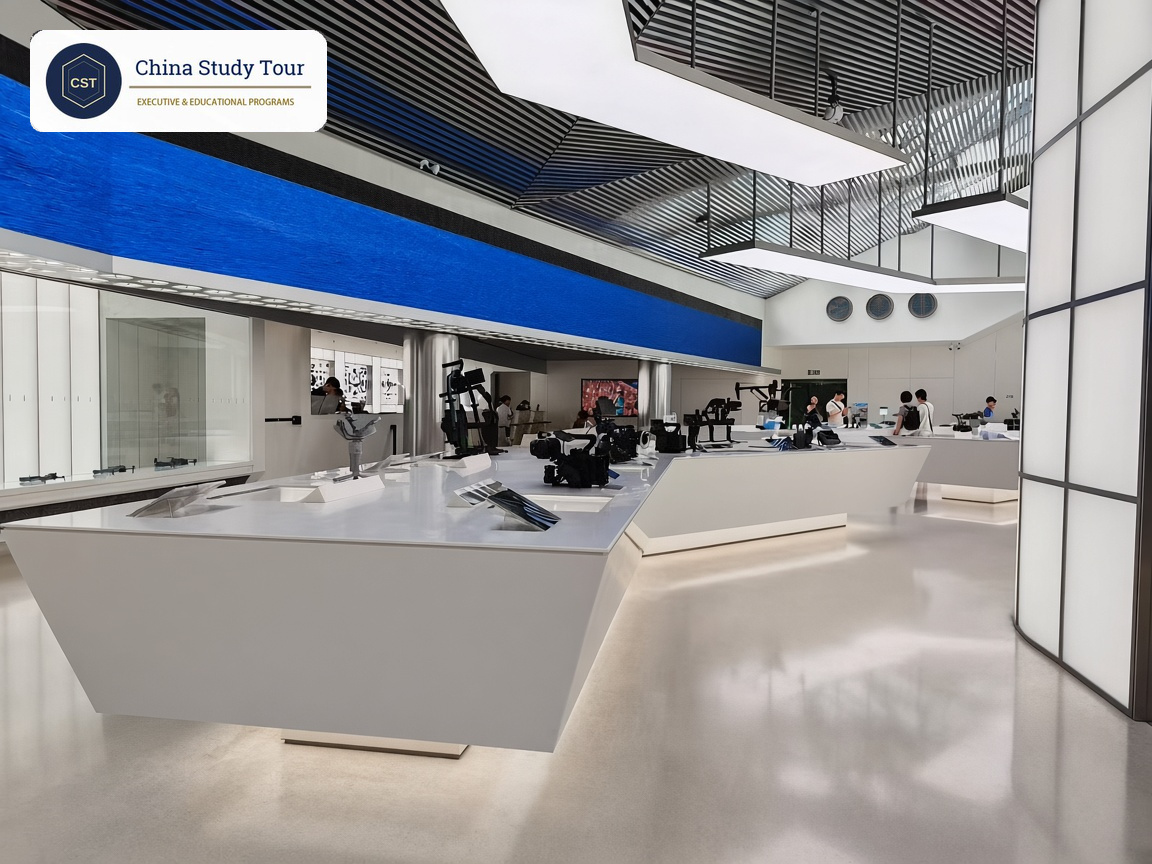
A DJI factory tour is not a walk-in attraction. Organized groups of 10 to 30 people book four to six weeks ahead through a vetted partner and follow a pre-agreed route: the product experience center, the smart manufacturing line, a flight-test demonstration and an engineer-led briefing. Core R&D, unreleased products and parts of production stay closed. The two hours you spend writing a question list before you fly will shape the visit more than anything else.
Key Takeaways
- No public tour, no ticket. Access runs through a partner who already has the relationship, which is why cold emails to DJI almost never work.
- Confirm five things first. Group size, the theme of the briefing, any hands-on add-on, your dates with a backup week, and what your group may photograph.
- Bring twelve questions. Well-framed questions on technology, manufacturing, global markets and organization get you further than any showroom walk.
- Reframe the closed topics. Four common questions will not be answered. Ask how a decision gets made instead of what the numbers are.
- Do not go to DJI alone. It works best as one stop on a two to three day Shenzhen route with Huawei and Tencent.
This guide assumes you have already decided to go. It covers the preparation work that most groups skip, based on what CST has seen work and fail on arranged company visits in Shenzhen. If you are still deciding whether the visit is worth the time, start with our DJI factory tour overview of what executives can and can't see, which covers the route in detail.
Why Preparation Decides the Outcome
DJI runs a controlled route. The host is usually an engineer or a senior trainer rather than a marketing guide, and the shape of the visit is fixed: showroom, line, test area, briefing. What is not fixed is the conversation. A group that arrives to look around gets the standard script. A group that arrives with a written question list gets a different visit in the same building and the same 120 minutes.
The reason is simple. The host reads the room. If nobody asks anything specific, the briefing stays at the level of company history and product families. If the second question is about how a supplier stays on the approved list, the rest of the session moves to how DJI actually operates.
There is a second reason, and it is about your own group. Executive delegations are good at spotting patterns but slow to admit they did not understand something. Twelve people who nod politely through a technical briefing often leave with three different versions of what they heard. A short pre-visit brief prevents that.
DJI Factory Tour Preparation: Five Things to Confirm
CST settles these items with each client before a request goes to DJI. When one is skipped, it usually becomes a problem two weeks before travel, when the options have narrowed.
| What to confirm | Why it matters | Decide by |
|---|---|---|
| Group size and decision makers | In our experience, ten to thirty people works best. Past that, the group splits and the briefing loses focus. A single executive should join or form a small delegation rather than expect a private session. | Before the request |
| The theme of the briefing | A briefing for a consumer electronics team and one for a logistics operator are two different sessions. Tell the host your sector, not just your company names. | With the booking |
| Hands-on add-ons | A supervised flight session or a RoboMaster session changes the timetable and must be arranged in advance, not on the day. | With the booking |
| Dates, plus a backup week | The Canton Fair and Chinese public holidays fill visit slots and Nanshan hotels at the same time. A backup week turns a rebooking problem into a small change. | Eight weeks before travel |
| Photo rules | Parts of the building restrict photography. Brief your group so nobody is corrected in front of the host. | Before you travel |
Lead time and language support
In CST's experience, lead time for one arranged visit is four to six weeks. If a changed slot would force your group to rebook flights, treat six weeks as the minimum.
Language support on CST programs: English, Chinese, Spanish, Portuguese, and Japanese. All guides are bilingual, and additional language support is available upon request.
DJI and China's other leading firms accept outside groups only through vetted partners with verified credentials. As a result, cold emails from individual companies almost never lead to a visit. China Study Tour (CST) has built its access over 13+ years of working relationships. Tell us your sector, group size and dates, and we will send a written plan showing which companies can realistically be confirmed in your window. Start a visit request.
Twelve Questions Worth Asking
Write these down, print them, and give them to whoever is confident enough to speak first. You do not need to ask all twelve. The point is to make sure the first two questions set the level for the session. Notice that every question asks how or why, because questions that ask for a number tend to end the conversation rather than open it. This list is the core of DJI factory tour preparation.
Technology and the product road map
| Question | What it opens up |
|---|---|
| Do the same engineers work on consumer and enterprise products, or are they separate organizations? | Shows whether the company is one engineering culture or several, and where talent goes. |
| Which parts of the flight controller, gimbal and video link are still built in-house, and which have moved to suppliers? | Vertical integration is the story people come for. This shows how far it actually goes today. |
| When a new sensor or chip becomes available, how long until it reaches a product on sale? | A concrete answer to the speed question that most delegations forget to ask. |
Manufacturing and supply chain
| Question | What it opens up |
|---|---|
| How much of the line we just saw is automated, and where does human inspection still beat a machine? | Most visitors assume full automation. The real answer is usually more interesting. |
| How does a new supplier qualify, and what makes one lose approved status? | Supply chain discipline is the least exciting and most transferable lesson of the visit. |
| When a quality problem reaches customers, how far back into the line does the investigation go? | Turns a general quality question into a question about how the organization learns. |
Selling outside China
| Question | What it opens up |
|---|---|
| Which market gave you the hardest regulatory problem, and how did the product change because of it? | Treats localization as an engineering limit, not a marketing exercise. |
| How much of the enterprise business is sold through local partners, and how do you keep the service standard? | Directly useful for any delegate who runs a sales channel or distribution network. |
| When a product line matures, what decides whether you keep it or fold it into a successor? | Product portfolio discipline, a live question for most hardware companies in the room. |
Organization and talent
| Question | What it opens up |
|---|---|
| How do you keep a large engineering organization moving as fast as a fifty-person company? | The organization question behind every hardware delegation's real interest. |
| What does one engineer own from start to finish, and at what point does a project change hands? | Ownership boundaries explain more about shipping speed than any process chart. |
| RoboMaster is an unusual thing for a hardware company to run. What does it give DJI as a business? | Opens the education and ecosystem story by asking about the business logic. |
Choosing your opening questions
Twelve questions, four themes. Pick three or four to lead with and let the rest come up naturally.
Questions That Will Not Get Answered
Setting this expectation before you travel is the difference between a group that feels well hosted and a group that feels blocked. None of these limits is unusual for a hardware company. Knowing them in advance keeps them from spoiling the visit.
| What visitors ask | Why it is closed | What to ask instead |
|---|---|---|
| Can we see the next product generation? | Unreleased product development sits in the closed part of the building. | What does the evaluation process look like between a finished prototype and a launch decision? |
| What are your unit volumes and margins? | DJI is privately held and does not publish financial results. | How do you decide which product lines get more investment next year? |
| Can we film the production line? | Some manufacturing steps and production data are proprietary, and photos are limited in parts of the building. | Which stage of assembly is hardest to get right, and why? |
| Can you introduce us to your component suppliers? | Supplier relationships are commercially sensitive on both sides. | What are the two or three things you look for in a new supplier? |
The reframe is always the same move: ask about the decision process rather than the output.
How to Brief Your Group
The last step of DJI factory tour preparation happens on the coach. Fifteen minutes is enough, and it repays the time many times over. Four points cover it.
First, say plainly that this is a curated route, not open access. Delegates who expect to walk freely around a factory floor will see a guided path as a restriction. Delegates who were told in advance will see the same path as access they could not have got on their own.
Second, name who the host is likely to be. An engineer or senior trainer, not a salesperson. That one sentence changes what people ask, because nobody wants to spend time with a technical host on basic company history.
Third, share out the questions. Split the twelve across three or four people, so one confident delegate does not carry the whole session and the quieter specialists have a reason to speak.
Fourth, set the debrief. Tell the group that 45 minutes after the visit, each person will name one thing they saw that applies to your own operation. Groups that do this come home with something usable. Groups that do not come home with photographs.
Photography, Confidentiality and Ground Rules
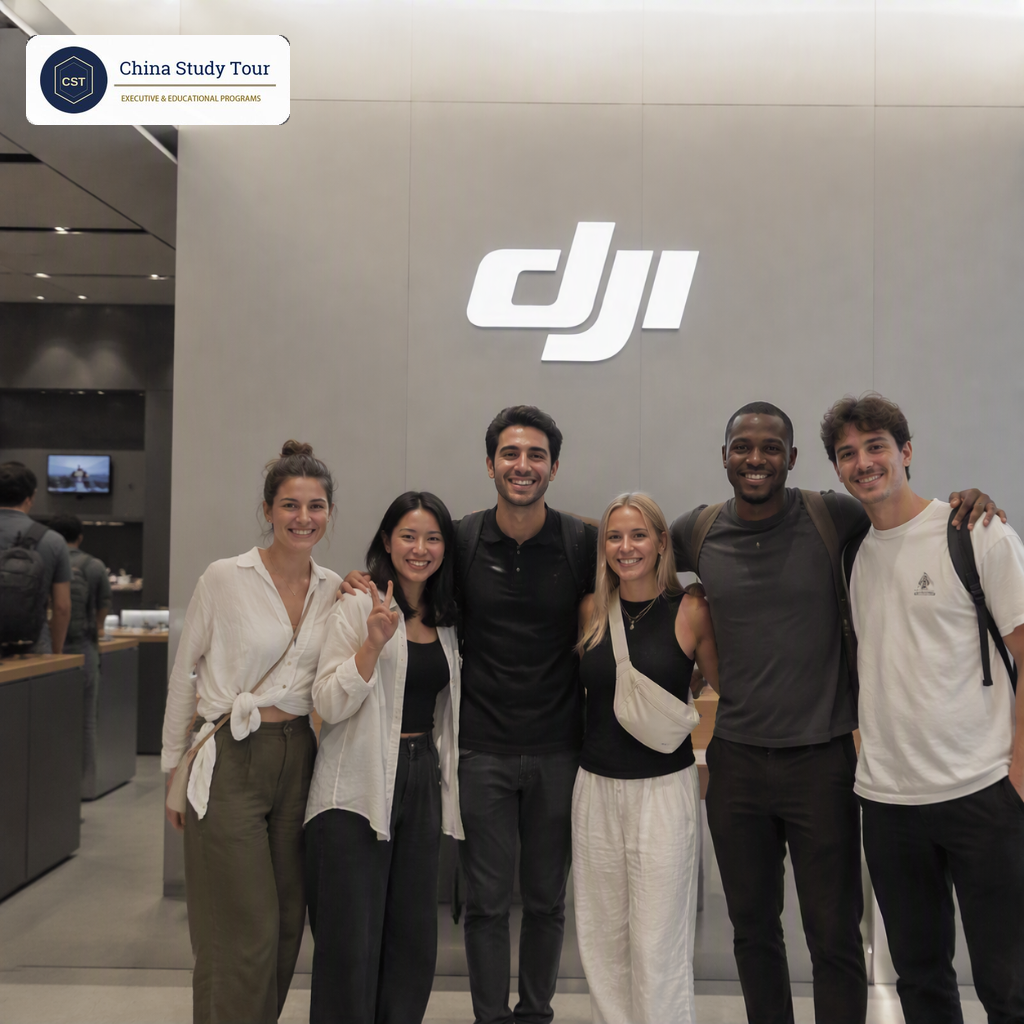
Three practical points come up on most trips. First, photography is restricted in parts of the building, so assume you need permission rather than assuming you have it. Second, where the route enters controlled areas, visitors sign in and follow a set path. Third, the interpreter is part of the arrangement, not something to improvise. A delegation that shares its question list with the interpreter beforehand gets noticeably better answers, because the interpreter can check a technical term with the host instead of guessing.
If your group includes anyone whose day job is procurement, add a note about commercial conversations. A company visit is not a supplier meeting, and treating it as one usually shortens it.
Where DJI Fits in a Shenzhen Program
DJI's Sky City headquarters sits in Nanshan, close to much of the city's technology cluster. The structure that works best is two to three days with one company per theme: DJI for drones, robotics and hardware integration; Huawei company visits for telecom and industrial systems; Tencent company visits for internet platforms and cloud. Each visit then answers a different question about how Chinese technology companies are organized, which is far more useful than three versions of the same story.
There is also a practical reason to spread the program across companies. Any single slot can move at short notice, and a program built around one main visit has no fallback. Our Shenzhen destination guide covers pacing and hotels, and our guide to which Chinese companies accept corporate visitors explains why some doors open easily and others do not.
Why the October to December window fills early
According to the Civil Aviation Administration of China (CAAC), China had more than 4.788 million registered drones by mid-2026. The CAAC also expects the low-altitude economy, meaning drones and other low-level flight services, to grow from RMB 1.5 trillion (about US$210 billion) in 2025 to RMB 3.5 trillion by 2035 (CGTN report on CAAC targets). That growth is one reason interest in DJI visits has risen. If your group is planning around the Canton Fair, expect the weeks around it to be tight for both access and hotels; our guide to factory visits around the Canton Fair shows how to fit both into one trip. Our China executive study tour team treats that calendar as part of program design rather than an afterthought.
A note for groups from the United States
In December 2025, the US Federal Communications Commission (FCC) added foreign-made drones to its Covered List. As of October 2026, new DJI models cannot be approved for the US market, although drones already in use can still fly. For US groups, this makes the regulatory question in the list above one of the most useful to ask.
This guide was written by the China Study Tour (CST) team in Shenzhen, which arranges DJI visits for international groups. The route, timing and access rules come from CST's arranged visits and DJI's own visitor requirements. DJI allows photos in display areas but limits them in parts of the building. Market and regulatory figures are a snapshot as of October 2026.
Frequently Asked Questions
Can I visit DJI for a factory tour without a booking?
No. DJI has no public factory tour and no ticket. It receives organized groups with a stated business or learning purpose, arranged through vetted partners. The flagship store on the ground floor of Sky City is open to the public, but the manufacturing line, flight-test area and briefing are only for booked delegations.
How far ahead should we book a DJI factory tour?
Four to six weeks is the working figure for one arranged visit. Book earlier around the Canton Fair and Chinese public holidays, when visit slots and Nanshan hotel rooms both tighten. If a changed slot would force your delegation to rebook flights, treat six weeks as the minimum. Booking too late is the most common reason a DJI visit does not happen.
What does a DJI visit actually include?
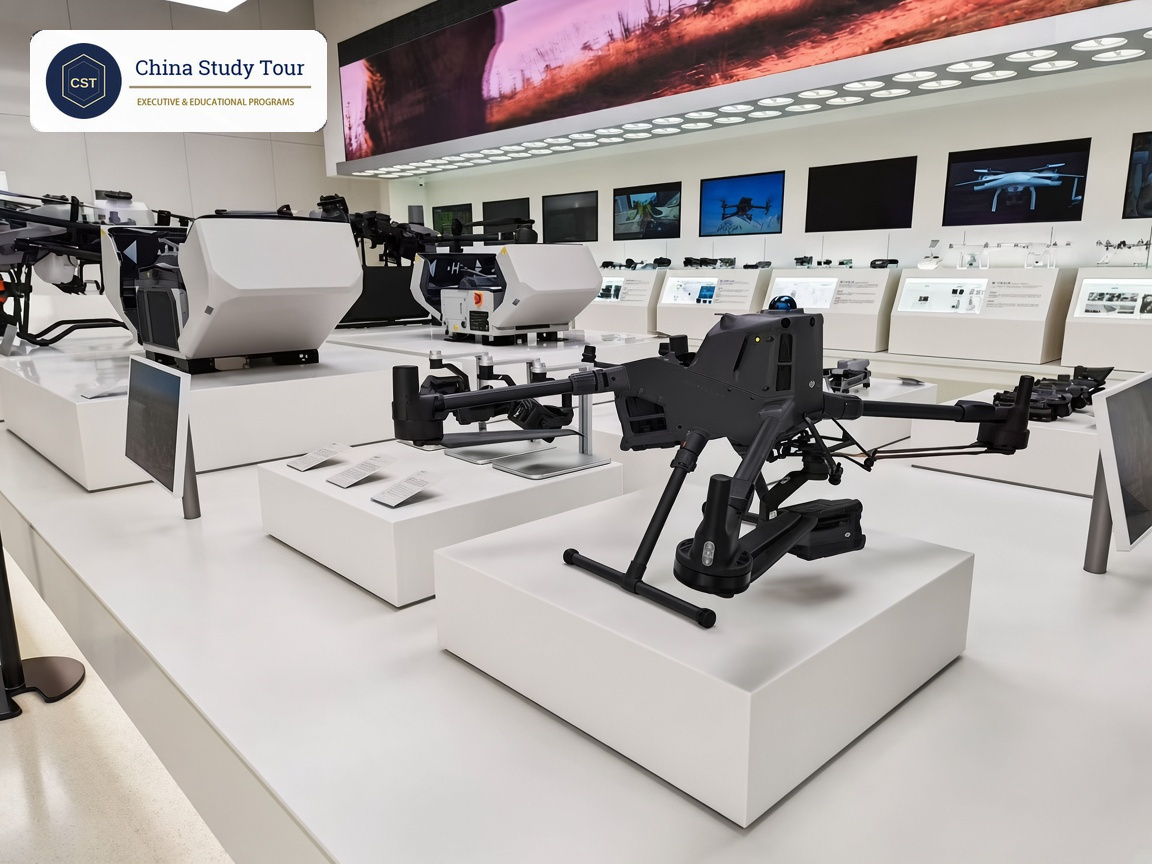
The standard visit runs about 120 minutes: the product experience center and its component teardown wall, the smart manufacturing line, a flight-test demonstration, and a briefing with Q&A led by an engineer or senior trainer. Half-day formats and add-ons, such as a guided flight session or a RoboMaster session, can be built in when the itinerary allows.
Can we fly drones during a DJI visit?
Often, yes, in a supervised area with certified trainers. It is arranged in advance as an add-on rather than included on every route, so raise it when you book. If flying is the main point of the trip for your group, say so before the route is fixed, because the add-on changes the timetable.
Which questions will DJI not answer?
Core R&D labs and unreleased products are not part of the route, and neither are some proprietary manufacturing steps, production data or supplier relationships. DJI is a private company, so unit volumes, margins and revenue splits are not shared. Ask how a decision gets made rather than what the numbers are, and you usually get a useful answer.
How do we combine DJI with Huawei or Tencent?
All three companies are in Shenzhen, so a two to three day route with one company per theme works well: DJI for drones, robotics and hardware, Huawei for telecom and industrial systems, and Tencent for internet platforms and cloud. A route with several companies also protects your program if one slot moves at short notice.
Tell us your delegation size, your sector and your preferred dates. We will confirm what is realistically available in your window and send a written, itemized plan.
Email: info@chinastudytour.ai·WhatsApp / WeChat: +86 131 6180 6706