
Canton Fair Delegation: How Chambers Use the Three-Day Gaps
A Canton Fair delegation is a group of member companies that goes to the fair together. A chamber of commerce or trade body usually leads it. This autumn the halls close twice: October 20 to 22 and October 28 to 30, 2026. A group of 15 to 20 can use one of those gaps for three days of company visits in Shenzhen and Guangzhou. But there's a catch: timing. Hosts need six to eight weeks, so most chambers are now planning for spring 2027.
- The 140th Canton Fair closes its halls twice for three days: October 20 to 22 and October 28 to 30.
- Phase 1 buyers (electronics, machines, vehicles, new energy) get the most from a robotics, EV and drone route.
- Each member signs up with the fair on their own. We book the company visits once, for the whole group.
- For spring 2027, send your member list before Chinese New Year on February 6. Approvals stall around it.
- Visa-free entry for about 50 countries ends on December 31, 2026, unless China extends it. Budget for visas in April.
What a Canton Fair delegation gets that a solo buyer doesn't
Most people walk the fair alone or with one colleague. A delegation works differently, though. The organizer signs members up before the fair, briefs them once, and moves them around Guangzhou on one schedule.
The fair wants these groups, too. Its partner list covers 227 business groups and trade bodies in 110 countries. Around 30 of them brought buyer delegations to the spring 2026 session, according to the organizer's own announcement.
Members get shared transport, one interpreter and a plan someone has already tested. But the real prize sits outside the halls. China's top manufacturers host groups with a clear purpose, and they almost never host a lone buyer. So a chamber's name on the request is often what gets the door open.
The two gaps in the 140th Canton Fair calendar
The fair runs in three five-day phases. In between, the halls close for three days while crews take one set of booths down and put the next one up.
| Dates (2026) | Status | Main categories |
|---|---|---|
| October 15 to 19 | Phase 1: Advanced manufacturing | Electronics, machinery, hardware, vehicles, new energy |
| October 20 to 22 | Halls closed | First three-day gap |
| October 23 to 27 | Phase 2: Quality home life | Housewares, gifts, furniture, building materials |
| October 28 to 30 | Halls closed | Second three-day gap |
| October 31 to November 4 | Phase 3: Better life | Textiles and apparel, toys, shoes and bags, food, medical |
Those closed days are your chance. After all, your members have paid for hotels and flights. They're in China with nothing booked. Besides, three days is exactly the length of a two-night visit program.
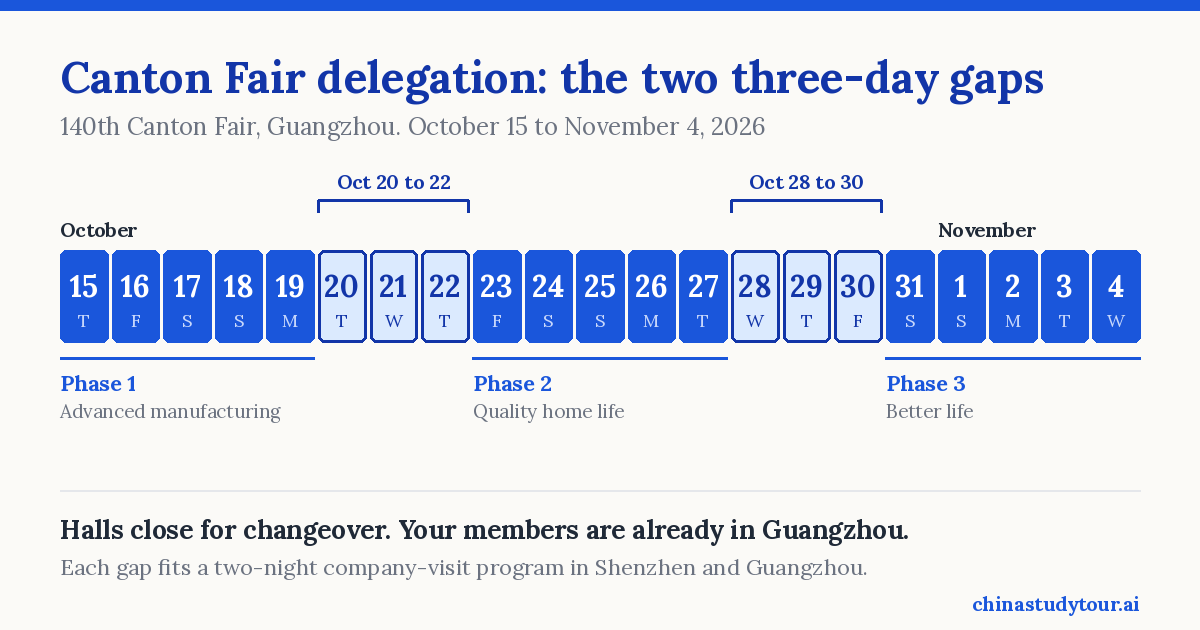
First, match the gap to the phase your members attend. Phase 1 buyers have just spent five days on parts, machines and vehicles. So a route through robot, EV and drone makers shows them the finished side of what they buy. Phase 2 buyers of furniture or building materials need a different route. For them the second gap works better, for example with a trip to the furniture cluster in Shunde.
A three-day route built for Phase 1 members
This is the route we run for tech and manufacturing groups. The order matters as much as the names.
| Day | Base | Two visits | What the group learns |
|---|---|---|---|
| 1 | Shenzhen | UBTECH (humanoid robots), then BYD (electric vehicles) | What the tech can do, then what it costs to build at scale |
| 2 | Shenzhen | DJI (drones), then ACCUTECH (SMT and PCBA electronics) | A niche product gone mass market, then the factory floor behind products like it |
| 3 | Guangzhou | Huayue Group, then GAC (car making) | Whether automation keeps up on a real line |
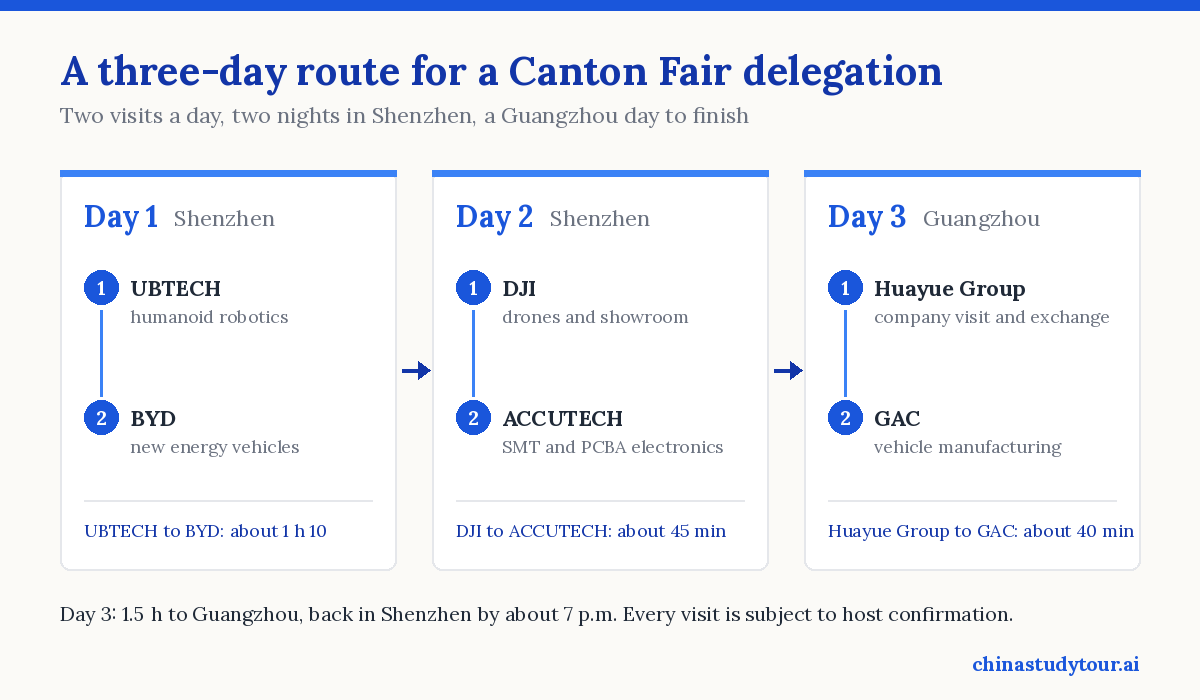
The program runs from a Shenzhen hotel, with two nights there and a Guangzhou day at the end. Day 1 leaves the hotel at 8:30 a.m., so move the group from Guangzhou on the evening Phase 1 closes. Ending in Shenzhen also suits members who fly home from Shenzhen or Hong Kong. If some members are staying for Phase 2, ask for a Guangzhou drop-off on day 3 instead. In that case, we quote any change of start or end city at cost.
Day 1: UBTECH and BYD
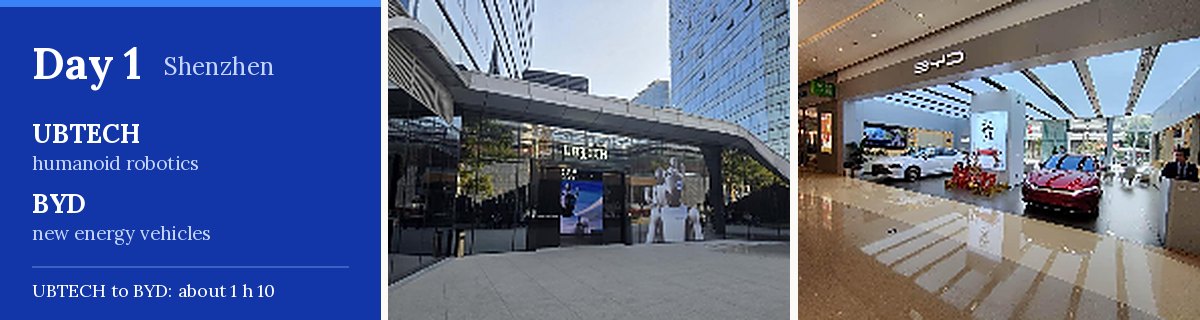
The morning starts at UBTECH with a company briefing. Then comes a robot demo and time to talk business. After lunch, the group drives about 55 kilometers, roughly 1 hour 10 minutes, to BYD. Once there, you'll get an EV tech briefing, a site visit and a Q&A with the host's team.
Day 2: DJI and ACCUTECH
DJI's morning session covers the company, its showroom and a product demo. Then, after lunch, it's a short hop, about 25 kilometers or 45 minutes, to ACCUTECH (Dingqin Technology). This SMT and PCBA electronics maker walks the group through a working production floor. Finally, a business meeting and a Q&A close the day.

Day 3: Huayue Group and GAC in Guangzhou
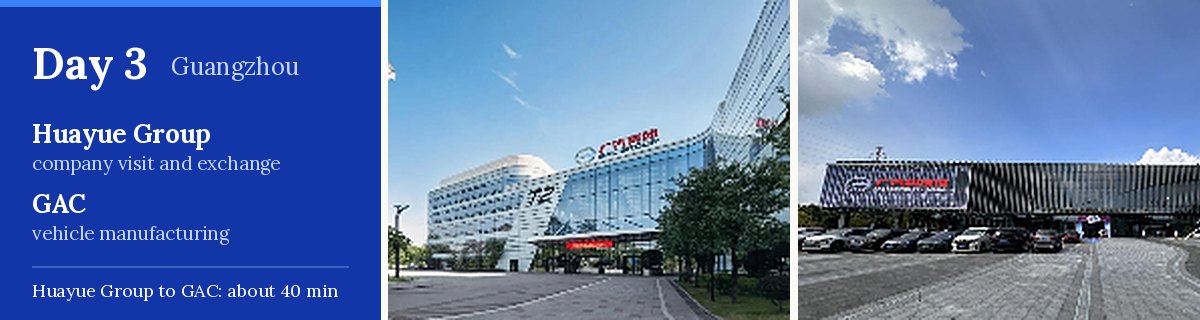
First, the group checks out at 8:30 a.m. and reaches Huayue Group in Guangzhou about 90 minutes later. Then, after lunch, it's a 40-minute drive to GAC for a car tech briefing and a factory visit. Finally, the day ends at 5 p.m., and the drive back to Shenzhen takes about two hours.
What a visit day feels like
Every stop follows the same rhythm. First comes a 45-minute company briefing. Then you get up to two hours of demos, a site walk and business talk. Lunch runs two hours, and that's where a lot of the real conversation happens. Afternoons then wrap at 5 p.m.
Two visits a day is the limit. That's because a third one turns the day into a commute with meetings attached. For the drive times hour by hour, see this breakdown of the changeover days.
Each host approves each group on its own. So we plan every day as requested visits, with a backup in the same sector. Nothing is final until the host says yes in writing. Our guides to BYD visits and DJI visits show what those two hosts share with groups.
Why 15 to 20 people
Hosts take groups of about ten to thirty. But 15 to 20 is the size that runs smoothly. One business minibus and one driver cover all three days, with no change of vehicle. Also, one interpreter can follow every session. And most briefing rooms and factory walkways fit a group this size in one go. Go above 20 and hosts often split the group, which doubles the time at each stop.
Mixed-language groups are common, especially from Latin America and the Gulf. Sessions can run in English, Chinese, Spanish, Portuguese, and Japanese. All guides are bilingual, and additional language support is available upon request.
Signing up the group: two tracks at once
Many organizers assume the fair sign-up covers the visit days. It doesn't. Instead, the fair and the company visits run on separate paperwork.
Track one: the fair
Each member signs up in their own name on the fair's official Buyer Service System. Online pre-registration and the buyer badge are free, and the badge carries that person's name. Members who need a visa can ask for an e-invitation in the same account. It then usually arrives within a few days to a week.
Track two: the company visits
We request the visits once, for the whole group. To start, we need four things:
- A short profile of the chamber and each member company
- Your member list with passport details
- Which gap you're aiming for
- Topics your group cares about most
Passport details cause the most trouble. That's because hosts register every visitor by name and passport number. So if a member renews a passport or sends a colleague instead, send us the new details right away. Otherwise security may stop that person at the gate.
A timeline for spring 2027
The fair hasn't set dates for the 141st session yet. If it follows the usual pattern, Phase 1 runs April 15 to 19, 2027. So the first gap would fall on April 20 to 22. Working back from there:
| When | Organizer | Members |
|---|---|---|
| By mid-January 2027 | Close the member list. Send profiles, passports and topics. | Confirm you're going and your passport is valid. |
| February 6, 2027 | Chinese New Year. Host approvals stop for about two weeks. | Nothing to do. Plan around it. |
| Late February to March | Collect host replies. Send invoices. | Sign up with the fair. Apply for a visa if you need one. |
| Early April | Final route and briefing pack. | Send three questions for each host. |
Chinese New Year is the date that catches people out. A request sent in late January can sit untouched until late February. By then there's too little time left before an April gap.
If you're reading this before the October 2026 session, the first gap is less than four weeks away. Electronics and parts makers can sometimes still take a late group. However, the best-known names usually can't at this notice. Even so, a smaller October trip is worth running. Above all, it gives you a tested route to sell to members for spring.
Invitation letters and visas for a mixed group
A Canton Fair delegation rarely shares one passport, so sort members into three groups early:
- Visa-free. Citizens of about 50 countries can enter China without a visa for up to 30 days on business. That covers both the fair and the company visits. The list includes Australia, Brazil, Argentina, Saudi Arabia and Spain. The UK and Canada joined on February 17, 2026.
- Two-way deals. The UAE and Thailand have their own mutual visa deals with China. Those don't depend on the end date below.
- Visa needed. US, Indian and South African passport holders still need a business (M) visa. The Canton Fair e-invitation supports the application. If a consulate asks, CST can add a letter that covers the program days.
One date matters for spring. China's visa-free policy ends on December 31, 2026. China has extended it before, but as of September 2026 there's no word on 2027. So tell visa-free members now that April may need a visa, and put the fee in the budget just in case.
Visa-free travelers should still carry proof of why they're coming: the fair invitation, a hotel booking and a return ticket.
Invoices: decide who pays before you recruit
Chambers pay for a Canton Fair delegation in one of two ways. Which one you pick changes what you promise members.
One invoice to the chamber. The chamber signs one contract, pays one deposit and bills members itself. It's simpler to run. But the chamber carries the risk if a member drops out late.
One invoice per member company. Each company pays its own share and gets an invoice in its legal name, which is what most finance teams need. The chamber still signs off on the program. It just stops acting as the bank.
Either way, get three things in writing. First, what's included: the minibus and driver, an English-speaking interpreter and their travel costs, visit setup and entry fees, plus tolls and parking. Second, what isn't: meals, visa fees, personal costs and travel insurance. Also, you can add hotels for the two nights at four- or five-star level, or leave them out. Third, what happens if a host cancels. That could mean a swap visit in the same sector, or a refund for that part.
Why the visits go through a partner
China's top manufacturers only take outside groups through vetted partners with a track record. A cold email, even on chamber letterhead, rarely gets a reply in time for a fixed fair date. CST's access comes from 13+ years of relationships, not a contact list.
The partner's job is specific. We match the group to hosts in the right sectors and send the passport list in each host's format. Then we agree the agenda with the host's visitor team and keep a backup in every sector. Replies come back on paper, which is what you need before you tell 20 members their trip is on.
Who joins a Canton Fair delegation
- Chambers of commerce and bilateral business councils
- Industry and trade groups whose members buy in Phase 1 categories
- Government trade missions and investment agencies
- Company buying teams traveling together
- Executive education groups attached to a trade mission
A single buyer can't book these hosts alone. Instead, the practical route is to join a chamber's group, or form a small one with peers.
Make the three days count
Groups that come home with decisions arrive with questions, not a list of company names. That's why we ask every group to send three questions per host a week before the trip.
Three questions work at almost every stop. What broke the first time they rolled this out? Which process did it replace? And what did that process cost before?
Then hold a 30-minute debrief each evening while it's fresh. One shared note from 20 members, sorted by sector, is worth more than 20 private impressions. For a fuller question list, see our China company visit guide.
Frequently asked questions
What is a Canton Fair delegation?
It's a group of member companies that goes to the fair as one party. A chamber of commerce, trade body or government trade office usually leads it. Members sign up with the fair one by one but share a plan, transport and interpreters. The group can also book company visits that single buyers can't.
When are the gap days at the 140th Canton Fair?
The halls close from October 20 to 22 and from October 28 to 30, 2026, between the three phases. The phases run October 15 to 19, October 23 to 27 and October 31 to November 4. So each gap is exactly three days long.
Is there still time to add company visits in October 2026?
Only partly. That's because hosts around the fair usually need six to eight weeks, and the first gap is less than four weeks away. Electronics and parts makers can sometimes take a late group. The biggest names usually can't, so most chambers are using October to test the route and recruiting for spring 2027.
When is the spring 2027 Canton Fair?
The 141st session doesn't have official dates yet. If it follows the usual pattern, the phases would run April 15 to 19, April 23 to 27 and May 1 to 5, 2027. So the gaps would fall on April 20 to 22 and April 28 to 30. Check the official site before you book flights.
Do delegation members need a visa for China?
It depends on the passport. Citizens of about 50 countries, including the UK, Canada, Australia, Brazil and Spain, can enter visa-free on business for up to 30 days. That policy runs until December 31, 2026. US, Indian and South African passport holders need a business (M) visa, and the Canton Fair e-invitation supports it.
How do members get a Canton Fair invitation letter and buyer badge?
Each member signs up in their own name on the fair's official Buyer Service System. Also, online pre-registration and the badge are free. Members who need a visa can ask for an e-invitation in the same account. Before you close your list, ask every member to confirm they've signed up.
Can the chamber pay one invoice for the whole delegation?
Yes, or each member company can pay its own share. One invoice to the chamber is simpler, but the chamber carries the risk if members drop out late. Invoices per company carry each company's legal name, which most finance teams need. Decide before you recruit, because it changes what you promise members.
Which companies can a Canton Fair delegation visit in Shenzhen?
Our Shenzhen route covers UBTECH for humanoid robots, BYD for electric vehicles, DJI for drones and ACCUTECH for electronics manufacturing. Every visit depends on the host saying yes, so a good plan keeps a backup in each sector. However, single buyers can't book these visits on their own.
Tell us which gap you're aiming for, how many members you expect and what they buy. Then we'll send a route and a request plan you can take to your members.
Request a delegation proposal