How to Arrange a BYD Factory Visit in Shenzhen
Key Takeaways
- BYD does not accept direct visit requests from individuals or companies. Access runs through official channels — in our case, long-term cooperation with government liaison and BYD's commercial department.
- The realistic lead time is 30–45 days, with a detailed application and personal vetting of every participant — and even then, rejection is possible.
- Manage your expectations: a standard visit is exhibition hall + production line, no photos on the line, no meeting by default, and core workshops stay closed.
- China's EV industry is much deeper than BYD and Xiaomi. If BYD says no, Huawei's auto ecosystem, Geely, XPeng and Li Auto often deliver a better visit than people expect.
- Changzhou — a city most visitors have never heard of — produces roughly a fifth of China's EV batteries, and is emerging as an alternative place to see BYD and the battery supply chain in one trip.
- Why every delegation asks for BYD (and Xiaomi)
- The honest part: what a BYD visit is — and isn't
- How access actually works
- What you'll actually see on the day
- If BYD says no: the EV landscape beyond two brands
- Changzhou: the battery capital nobody told you about
- How I build an itinerary around BYD
- A story about what really matters in factory visits
- FAQ
Why Every Delegation Asks for BYD (and Xiaomi)
In thirteen years of arranging company visits in China, no request comes up more often than this one: "Can we visit BYD?" Usually followed a breath later by: "And Xiaomi?"
Among all the EV-focused groups I've hosted, essentially everyone names these two companies first. It makes sense — they are the two Chinese automakers with the loudest global reputations, the ones people have already read about at home. Interestingly, most of the people asking are not from the automotive industry at all. They come to understand China's new-energy vehicle story with their own eyes, walk a real production line, and take a test drive.
What they don't know — and what I always have to explain first — is that these are two of the hardest doors to open in China. Xiaomi, in particular, is close to impossible for foreign groups to book at the moment. BYD is possible, but only on BYD's terms, on BYD's timeline, and never guaranteed.
The Honest Part: What a BYD Visit Is — and Isn't
Before I explain how to get in, let me tell you something most operators won't, because I'd rather you hear it from me now than feel it on the factory floor later.
I have watched delegations wait 45 days, pass the vetting, pay a premium price, walk through the gates full of anticipation — and come out slightly deflated. Not because the visit was bad, but because their mental picture didn't match reality. The cost is high. The tours often run with many participants. The guides are professional but cannot answer every technical or strategic question a curious executive brings. You will not wander freely; you will follow a fixed route.
A BYD visit is genuinely worth doing — the scale alone changes how people think about Chinese manufacturing. But it is a structured corporate reception, not a private backstage pass. Knowing that in advance is the difference between a satisfied group and a disappointed one.
How Access Actually Works
Here is the part that surprises almost everyone: BYD does not directly receive visitors. There is no booking page, no tour desk, and emails sent cold to BYD asking for a factory tour generally go nowhere.
The way we arrange access is through long-term, working relationships built over years — through government liaison channels and deep cooperation with BYD's commercial department. This is not something that can be improvised for a single trip; it's the accumulated result of running delegations since 2013. I consider it the single most valuable asset in this part of my work.
The process, from your side, looks like this:
| Stage | What happens | Timing |
|---|---|---|
| 1. Request & profile | You tell us who is coming, from where, and why. We assess honestly whether the group fits BYD's reception criteria. | Day 1–3 |
| 2. Documentation | A detailed application is prepared: company background, full participant list with personal information for vetting, and purpose of visit. | Week 1 |
| 3. Submission & review | The application goes through the official channel. Every participant is vetted individually. | 30–45 days total |
| 4. Confirmation — or rejection | If approved, the date and format are fixed. If rejected, we pivot immediately (see below). | Before travel |
And yes — even a complete, well-prepared application can be rejected. It happens, and the reasons are rarely explained. When it does, I tell clients the same thing every time: don't worry, and don't take it personally. We arrange a comparable automaker instead. After hosting this many groups, my honest recommendations are Huawei's automotive ecosystem, Geely, XPeng and Li Auto — delegations consistently come away from those visits with the answers they originally wanted from BYD.
What You'll Actually See on the Day
A standard automaker visit in China — BYD included — follows a fairly consistent format, and it's worth knowing before you go:
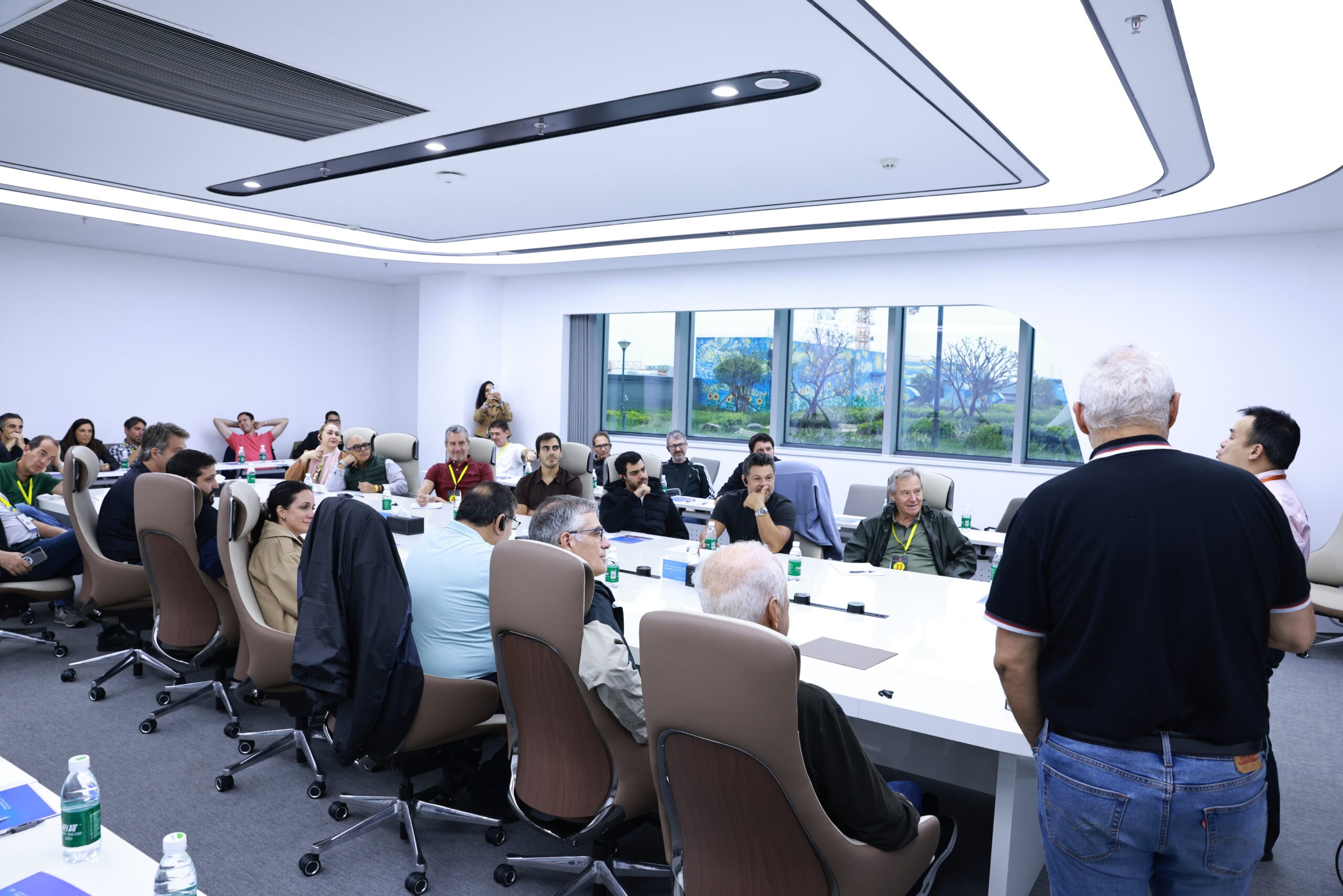
- No business meeting by default. The standard visit is a tour, not a conference. If your group needs a sit-down exchange, it must be requested and arranged separately, in advance.
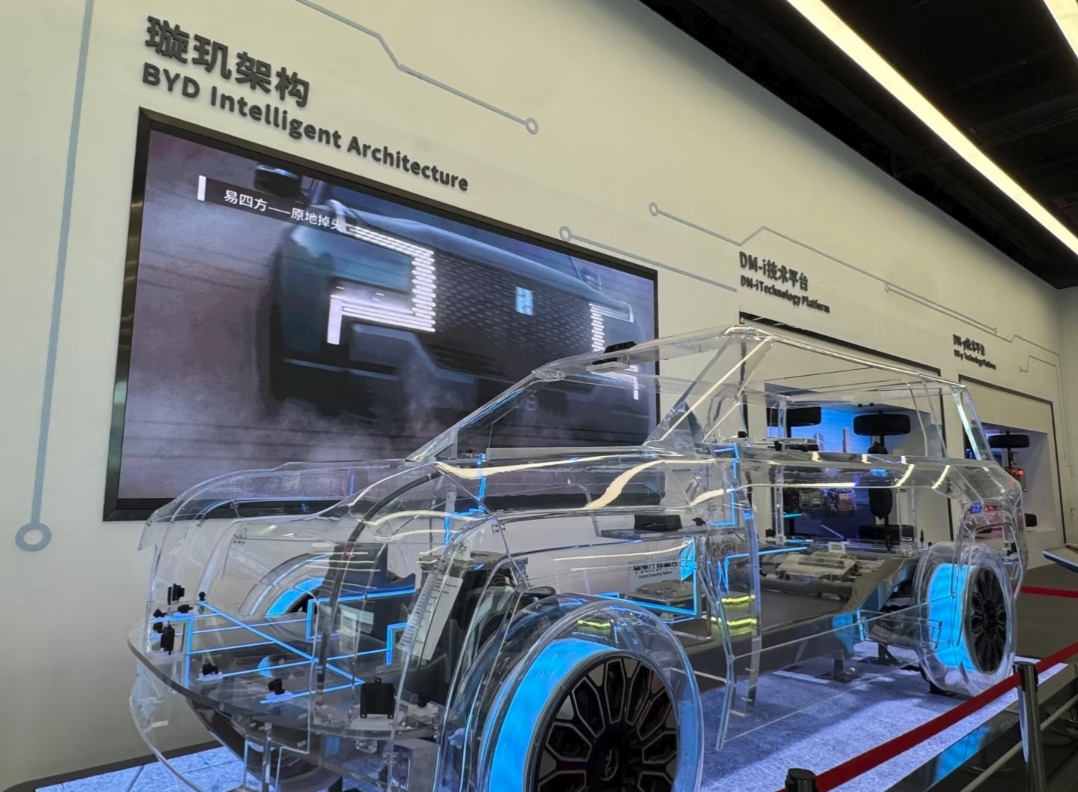
- Exhibition hall first. Vehicle lineup, technology displays, company history. This is where photos are allowed and where the test-drive interest usually gets satisfied.
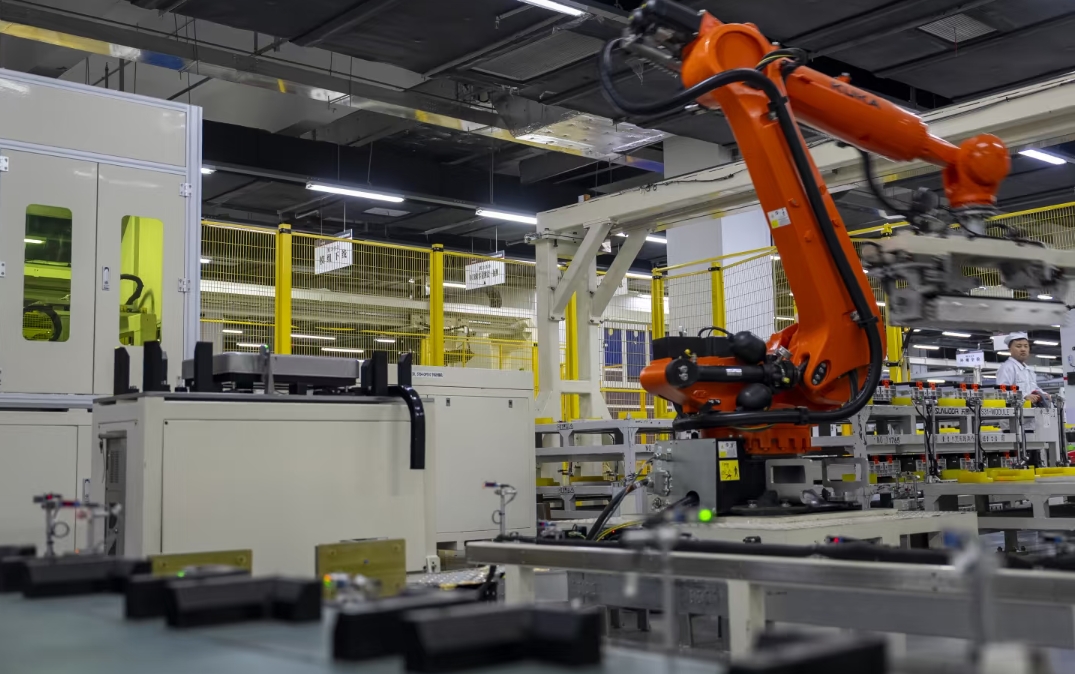
- Then the production line. Two kinds of workshops are typically opened to visitors: the components workshop, which is almost entirely automated — machines running with barely a human in sight — and the final assembly workshop, where you watch workers and machines fitting complete vehicles together in coordination. Seeing those two side by side is, for most visitors, the moment China's manufacturing reality clicks.
- No photography on the production line. None. This is enforced, and I brief every group on it beforehand.
- Core workshops stay closed. Battery cell production and other sensitive processes are not part of any visitor route, no matter who is asking.
If BYD Says No: The EV Landscape Beyond Two Brands
Here's what I wish more delegations understood before fixating on two logos: China's EV industry is not BYD plus Xiaomi. There is an entire ecosystem of automakers doing world-class work in their own verticals — many of them more accessible, and often more relevant to what a specific group actually does.
The way I explain the landscape to clients, it breaks into three camps: the established auto groups, the "new forces," and the tech cross-overs. Let me walk through each — because somewhere in this list is almost certainly a better match for your delegation than the name you arrived with.
First, understand what "BYD" itself actually includes
Even the delegations who insist on BYD usually don't realize that BYD is not one brand — it's a four-tier brand matrix, and knowing it changes what you ask to see:
| BYD brand | Market position | What it tells you about the company |
|---|---|---|
| Dynasty & Ocean networks | Mass-market sedans and SUVs — the volume engine, with model families like Yuan, Song and Sealion each selling in the tens of thousands per month | Where BYD's cost and scale advantage from full vertical integration shows most clearly |
| Fang Cheng Bao | Rugged, personality-driven off-road SUVs | BYD competing in lifestyle niches, not just volume |
| Denza | Premium family SUVs and business MPVs (the D9 is a fixture of Chinese executive transport) | The push upmarket into premium comfort |
| Yangwang | Million-yuan super-luxury cars and supercars | The technology flagship — where BYD showcases its most advanced platform engineering |
As of mid-2026, the group is delivering on the order of 1.7 million+ vehicles per half-year. When you stand in the exhibition hall, you're looking at all four tiers at once — which is exactly why the showroom stage of the visit is worth more attention than groups usually give it.
Camp one: the established auto groups
These are the decades-old giants with complete supply chains and deep pockets. They've long moved past "experimenting" with EVs — every one of them now runs a multi-brand new-energy matrix and is expanding aggressively overseas:
| Group | Key NEV brands | Signature models & strengths |
|---|---|---|
| Geely Holding | Geely Galaxy, Zeekr, Lynk & Co | Galaxy's Xingyuan is a mass-market bestseller; Zeekr leads premium pure-electric MPVs (009) and large SUVs (9X); Lynk & Co holds the sporty mid-premium lane |
| Changan | Qiyuan, Deepal, Avatr | Qiyuan owns the value-for-money compact segment; Deepal targets younger buyers and is expanding overseas fast; Avatr carries the high-end intelligent-driving flag |
| Chery Group | Chery, Jetour, iCAR, Exeed | China's export champion; Jetour dominates the "travel + off-road" niche; iCAR's boxy V23 is a youth-market hit |
| GAC Group | Aion, Hyptec, Trumpchi | Aion is a force in the 100–200k RMB pure-electric market; Trumpchi's M8 leads premium MPVs |
| SAIC | IM Motors, Roewe, MG | IM Motors for premium intelligent EVs; MG is one of China's most successful auto brands in Europe, with the MG4 pioneering semi-solid-state batteries |
| Dongfeng | Voyah, eπ, Aeolus | Voyah is the leading state-owned premium NEV brand — its Dreamer MPV tops the segment |
| FAW | Hongqi NEV, Bestune NEV | Hongqi carries unmatched "national car" prestige in premium business sedans and SUVs |
| Great Wall Motor | Tank, Haval, WEY, Ora, GWM Poer | Tank rules hard-core off-road SUVs (strong in markets like Saudi Arabia); Haval H6 is a national-favorite family SUV; Poer leads pickups |
Camp two: the new forces
Born around 2014–2015, electric from day one, software-first by instinct. After years of brutal shakeout, four names lead the pack — and all four make excellent visits:
| Company | Known for | Scale (H1 2026 deliveries) |
|---|---|---|
| Leapmotor | "Good but not expensive" — over 65% of components developed and built in-house, which makes its factory story unusually interesting | ~356,000 — currently the new-forces leader by volume |
| Li Auto | Extended-range family SUVs; arguably China's sharpest product-definition company | ~193,000 |
| NIO | Premium pure-electric with battery swapping — its swap-station network is a visit highlight in itself — plus a three-brand structure (NIO, Onvo, Firefly) | ~191,000 |
| XPeng | Autonomous driving as the core identity, now pushing advanced driver assistance into affordable models like the MONA M03 | ~166,000 |
Camp three: the tech cross-overs
This is the camp foreign visitors find most fascinating, because nothing like it exists in their home markets — consumer-tech giants building cars as part of a connected ecosystem:
- Xiaomi Auto. The SU7 sedan and YU7 SUV turned Xiaomi into a top-tier EV player almost overnight, on the strength of its "person–car–home" ecosystem and consumer-electronics cost discipline. As of mid-2026 it delivers 30,000+ vehicles a month — and, as I said at the top, it is also the single hardest visit to secure for foreign groups.
- Huawei (Harmony Intelligent Mobility / HIMA). Huawei doesn't build cars under its own badge — it deeply co-develops them with partner automakers: AITO (with Seres), Luxeed (Chery), Stelato (BAIC), Maextro (JAC) and Shangjie (SAIC). The AITO M9 anchors the premium market, and the alliance delivered roughly 240,000 vehicles in the first half of 2026. For delegations interested in smart cockpits and autonomous driving rather than stamping lines, a Huawei-ecosystem visit is often the more relevant choice — and considerably easier to arrange than BYD.
And the camp nobody thinks about: commercial vehicles
Beyond passenger cars, China has giants that foreign visitors almost never consider: Yutong dominates electric buses and coaches, Sany and XCMG are electrifying heavy trucks, and Geely's Farizon leads new-energy logistics vans. They rarely appear on consumer sales charts because they sell to fleets and cities — but they are a huge part of how Chinese EVs are actually going global. If your delegation is in logistics, public transport or construction, these visits are frequently more valuable than a passenger-car factory — and if your business sits in one of these verticals, a matching automaker visit can be arranged around exactly that.
Changzhou: The Battery Capital Nobody Told You About
Now let me tell you about a city that isn't on any foreign delegation's list — and should be.
There is a city in China that ranks among the global leaders in EV power batteries, and most international visitors have never heard its name: Changzhou. The numbers are hard to believe until you see the industrial parks yourself: annual EV output has passed 800,000 vehicles, the city produces roughly one-fifth of China's power batteries, and by common local reckoning, about one in ten new-energy vehicles worldwide carries a Changzhou-made battery.
I'll admit my bias openly: Changzhou is my second hometown. I studied there, worked there, bought my first home there, and started my first business there. I know its factories, its ports on the Yangtze, its old canal, and its industrial character — a city built almost entirely on homegrown manufacturers with a deep industrial base, sitting within reach of Shanghai and the Ningbo ports.
Here is why this matters for your planning: we are currently working with the local government side so that, in the near future, visiting BYD won't necessarily require going to Shenzhen at all. In Changzhou, a single compact trip could cover BYD's local base, Li Auto, and the battery giants — CALB, CATL facilities and SVOLT. For any group whose real interest is batteries and vertical integration rather than a brand logo, that combination is arguably a stronger program than Shenzhen itself.
How I Build an Itinerary Around BYD
First, the budget conversation, because I believe in having it early: BYD is a stop for delegations with a proper budget. Between the access requirements, the reception costs and the standard of the rest of the trip such groups expect, it does not belong in a budget program — and forcing it into one disappoints everyone.
For the structure, my standard formula for a corporate delegation is one company from each pillar of Chinese innovation:
- One automaker (BYD, or one of the alternatives above)
- One robotics company
- One drone company
- One AI company
- Plus additional visits chosen around the group's own industry and interests
For duration and route, I recommend seven days, across three cities. The combinations that work best in practice: Beijing – Shanghai – Hangzhou, or Shanghai – Hangzhou – Shenzhen, or Shenzhen – Guangzhou – Shanghai.
And one conviction I hold strongly after thirteen years: I do not build crammed schedules. Some operators pack every day from early morning to late evening; the group ends the week exhausted, and the visits blur together. Seven days with breathing room lets people absorb what they're seeing — and actually enjoy China while they're at it. That enjoyment shows up later in how much they remember.
A Story About What Really Matters in Factory Visits
Let me close with a story. It isn't a BYD story — and that's exactly why I'm telling it, because it shows the thing about factory visits that no amount of advance planning can remove.
A 20-person delegation from Poland came to China to study factory automation. One of their key stops was the SAIC Volkswagen plant in Shanghai. We arrived on schedule — and were told at the gate that the automation workshop they most wanted to see, the body panel processing line, had gone down for unplanned maintenance that very day. The workers were mid-repair. There was nothing anyone could do; these temporary stoppages happen in every factory in the world, they are not announced in advance, and often nobody — including us — knows until arrival.
The clients were visibly disappointed. I understood completely: they had crossed the world for this.
So we moved. The group's schedule had breathing room (see above — this is why I build itineraries that way), and the Baosteel plant with its own automation workshops was not far. We coordinated on the spot, and that same window the delegation walked Baosteel's automated production lines instead.
At the end of the trip, their feedback told the whole story: the overall program scored a 10 out of 10. The Volkswagen stop — through nobody's fault — a 3. The improvised Baosteel visit: a 9.
Now connect this back to BYD: a slot booked 45 days in advance, with vetted participants, cannot simply be moved if something changes on the ground. That is precisely why the rest of the itinerary — the alternatives bench, the local relationships, the slack in the schedule — matters more than the single famous name at the top of your wish list.